Your weekly briefing on the HR and HR technology developments that matter to small and medium-sized employers across Europe.
Big picture: Europe’s AI rulebook moves, the work doesn’t
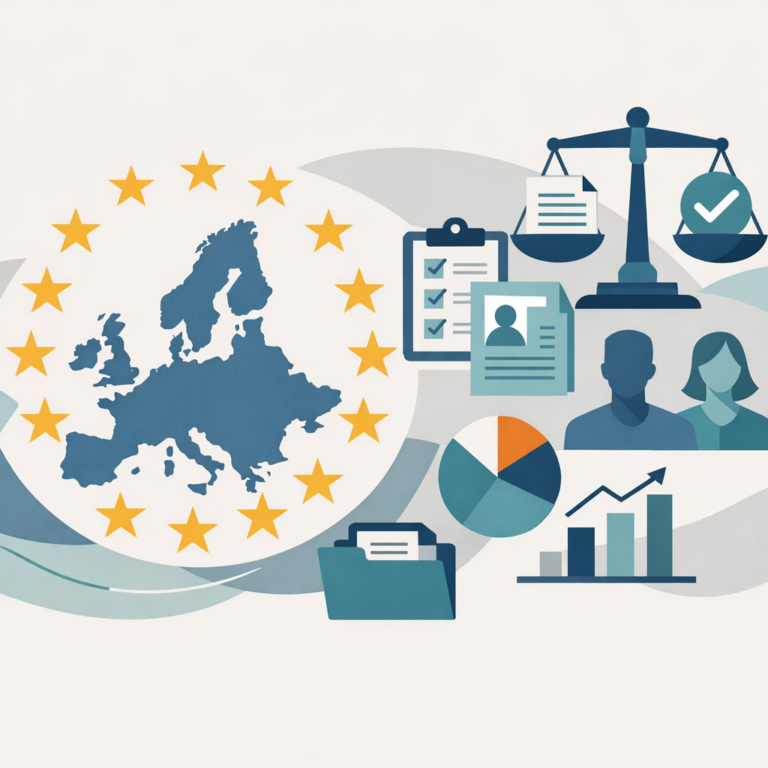
The Digital Omnibus entered into force on 27 July 2026 and pushed the compliance deadline for high-risk AI systems used in employment decisions from 2 August 2026 out to 2 December 2027, according to analysis from DLA Piper and Travers Smith. What did land on 2 August 2026 are the Article 50 transparency obligations, enforcement powers over general-purpose AI and the full penalty regime, so chatbot disclosure and AI-content marking are live now. The high-risk category still covers systems used for recruitment, promotion, termination, task allocation and the monitoring or evaluation of worker performance, with penalties for high-risk breaches reaching up to €15 million or 3% of global annual turnover, whichever is higher. Employment lawyers advising on the change, including Ogletree, are consistent on the point: employers shouldn’t wait, and should start by reviewing which AI tools they use and how.
Waarom het belangrijk is: if you’re a 10 to 500 person employer, you’ve gained time rather than a reprieve. The cheapest version of this work is an inventory of every tool in your HR stack that touches a hiring, performance or monitoring decision, and it’s far easier to build now than in late 2027.
Op de radar
Pay transparency is the deadline that didn’t move. Only five of 27 member states had transposed the EU Pay Transparency Directive as of August 2026, and just 9% of European employers have a fully implemented pay transparency strategy, per Trusaic’s transposition update. The 7 June 2026 transposition deadline has passed and the Commission has signalled no pause and no extension. Lewis Silkin notes that the substantive provisions, including compliant pay structures, pre-employment pay transparency and the right to information, apply from 1 November 2026, with first gender pay gap reports due by 7 June 2027 from employers with 150 or more workers, covering 2026 data.
The AI adoption gap is wider than the headlines suggest. SHRM’s State of AI in HR 2026 found that 39% of organisations had implemented AI for one or more HR activities, with a further 7% planning to do so this year, while 54% have adopted none and have no plans to in 2026. Recruiting leads at 27% of organisations, followed by HR technology management (21%), learning and development (17%) and employee experience (14%). Set against that, 92% of CHROs expect greater AI integration in the workforce, which is a sizeable gap between the boardroom and the day job.
HR headcount isn’t shrinking. In a piece published on 13 August 2026, Josh Bersin argued that HR jobs are booming despite massive AI investment. It’s a useful counterweight to the automation narrative and it matches what smaller teams tend to see in practice: automating administrative work frees capacity rather than removing roles, because the queue of neglected people work is usually long.
Skills-based hiring hits a verification problem. SHRM’s talent acquisition outlook describes 2026 as the year skills overtake degrees as the leading hiring criterion, but reports that 53% of employers cite verifying skill claims as their main obstacle. The framing is precision over scale: the advantage goes to teams that move verification earlier in the funnel, not to teams that simply hire faster.
UK employers face a second wave in October. Blake Morgan and Littler both confirm the next phase of the Employment Rights Act 2025. The employment tribunal claim time limit rises to six months on 1 October 2026 and new trade union obligations start the same day. From 30 October 2026 a duty to take all reasonable steps to prevent sexual harassment takes effect, alongside employer liability for harassment by third parties such as customers and suppliers, where a single incident may be enough to fix liability.
HR tech horloge
Skello haalt €200 miljoen op voor Europese expansie. French workforce management provider Skello secured a €200 million investment led by Bridgepoint, announced on 6 July 2026, to consolidate its position in France, accelerate European expansion and invest further in AI and targeted acquisitions. Bridgepoint says the company plans to hire around 100 more people in 2026. Skello’s focus on frontline scheduling puts it squarely in SME territory, so expect more competition for shift-based employers in retail, hospitality and care.
Investors are backing incumbents over moonshots. UNLEASH’s read of the biggest 2026 HR tech rounds quotes Ralf Hofmann, managing partner and co-founder at Drake Star, describing the year as “a disciplined recovery” in which investors are “selectively writing large checks again, but only for companies that can demonstrate sustained, profitable growth rather than just a compelling story”. For buyers, that points to fewer new entrants and more consolidation, which is worth factoring into any multi-year platform decision.
Agentic AI dominates the award shortlists. HR Tech Breakthrough announced winners of its inaugural awards on 12 August 2026, spanning talent acquisition, employee experience, workforce analytics, payroll and performance management, and the finalists for the second HR Icons Awards were published on 11 August 2026. The common thread across both is agentic AI and intelligent automation, though the HR Icons categories are aimed at organisations with 500 or more employees, so read the winners as a signal of direction rather than a shopping list.
Voor HR-teams van het midden- en kleinbedrijf
Three concrete things this month. First, build the AI tool inventory: every system that touches hiring, performance, task allocation or monitoring, with the provider, what it decides and who reviews the output. That single list underpins both AI Act readiness and sensible internal governance, and it’s an afternoon of work. Second, check your job adverts against the pay transparency rules in each market you hire in, because salary ranges in adverts and the ban on asking about salary history are the fastest requirements to get wrong and the easiest to fix. Third, if skills-based hiring is on your agenda, add one short structured work sample to your existing process before you buy anything: verification earlier in the funnel is what makes the approach work. UK employers should also put 1 and 30 October in the diary now and start reviewing harassment policies.
Bronnen
- DLA Piper over de Digital AI Omnibus en het uitstellen van verplichtingen voor hoogrisico-AI
- Travers Smith on the EU agreement to delay key AI Act compliance deadlines
- Ogletree on delayed rules for AI use in employment decisions
- Trusaic’s August 2026 EU Pay Transparency Directive transposition update
- Lewis Silkin’s EU Pay Transparency Directive employer compliance update
- SHRM, The State of AI in HR 2026
- SHRM, five critical insights for CHROs from the State of AI in HR 2026
- Josh Bersin on HR jobs booming despite AI investment
- SHRM on precision hiring and the new rules of hiring in 2026
- Blake Morgan on confirmed October 2026 Employment Rights Act dates
- Littler on the next phase of UK Employment Rights Act changes
- Bridgepoint press release on Skello’s €200 million investment
- EU-Startups on Skello’s funding for frontline workforce management
- UNLEASH on what the biggest 2026 HR tech funding rounds tell buyers
- HR Tech Breakthrough Awards inaugural winners announcement
- Finalists of the 2026 HR Icons Awards
- SHRM, The Download: HR technology trends, August 2026
HR Radar is een wekelijkse informatieve samenvatting van publiekelijk gerapporteerde HR- en HR-technologieontwikkelingen en -trends. Het is geen juridisch of professioneel advies.