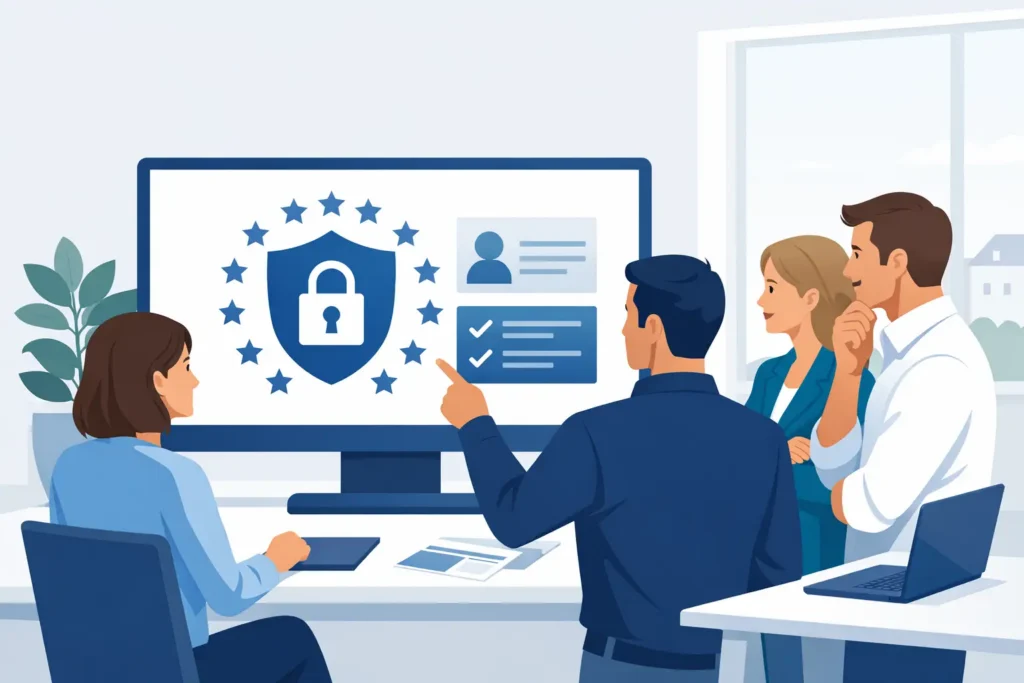
A spreadsheet with salary data in one folder, onboarding documents in another app, and manager notes sitting in email is usually where the GDPR risk starts. By the time a company begins looking for GDPR compliant HR software, the real problem is often not one bad tool. It is fragmented HR operations, unclear ownership, and too many places where employee data can spread.
For small and mid-sized companies, that matters because HR data is some of the most sensitive information the business holds. Employment contracts, absence records, performance feedback, compensation details, visa documents, disciplinary notes, and bank information all need careful handling. If your HR stack has grown tool by tool, privacy risk tends to grow with it.
What GDPR compliant HR software should actually do
A useful way to evaluate GDPR compliant HR software is to stop thinking in terms of a badge or a checkbox. GDPR compliance is not a product feature you switch on. It is the result of how the software is built, where data is stored, who can access it, how vendors contract with you, and how your internal team uses the system.
That is why two platforms can both claim to support compliance while offering very different levels of risk control. One may give you granular permissions, clear retention settings, and strong audit trails. Another may technically process HR data but leave too much to manual workarounds.
In practice, HR software should help you limit data exposure, keep records accurate, respond to employee requests, and prove that appropriate controls are in place. If the platform makes those tasks harder, it is not helping your compliance posture, no matter how polished the interface looks.
The first questions to ask any vendor
Start with data location. If employee data is stored or backed up outside the environment you expect, that affects your legal review immediately. For many European businesses, EU data residency is not just a preference. It reduces complexity, especially when HR teams are already managing cross-border employment issues.
Next, ask about the hosting model. Multi-tenant systems are common and can work well, but they are not the same as a dedicated environment. A single-tenant setup gives stronger isolation between customers, which can matter if your leadership team is especially cautious about employee data, or if your company operates in regulated sectors.
Then ask how the vendor handles subprocessors, data processing agreements, retention, deletion, and breach response. If the answers are vague, that is useful information. Good vendors can explain these topics clearly because they deal with them every day.
Core capabilities that reduce GDPR risk in HR
The most practical GDPR compliant HR software usually gets the basics right before adding anything more advanced. Role-based access is one of those basics. HR should not need to rely on broad admin rights just to complete normal tasks. Managers should only see data relevant to their teams. Finance may need expense information but not performance notes. If access rules are too blunt, privacy risk rises fast.
Auditability matters just as much. When someone edits a record, approves leave, uploads a document, or changes a contract field, the system should log that action. This is not just about investigations after something goes wrong. It helps teams answer ordinary questions quickly and confidently.
Retention controls are another area where many buyers underestimate the importance of the product design. HR teams often know they should not keep personal data longer than necessary, but if the system has weak archive and deletion workflows, old data lingers. A platform should make retention manageable, not depend on HR remembering to clean up records manually across several tools.
Data subject rights are also worth testing in real terms. Ask how the system supports access requests, corrections, and deletion workflows where legally applicable. If exporting a full employee record takes hours of manual effort from different systems, the burden falls back on your team.
Why fragmented systems create compliance problems
Most HR leaders do not wake up wanting a single platform for philosophical reasons. They want fewer handoffs, fewer duplicate records, and fewer places where things break. GDPR adds a strong operational reason to consolidate.
Every extra tool in your HR stack creates another place where personal data is captured, copied, synced, or stored longer than expected. Recruiting may hold candidate records in one system, onboarding documents may live in another, time and attendance in a third, and performance conversations in a fourth. Each handoff introduces risk.
This is where platform design affects compliance in a very practical way. When recruiting, onboarding, leave, expenses, and performance management run in one system, data governance gets easier. Permissions are easier to define. Records are easier to locate. Offboarding is easier to complete thoroughly. Your HR team spends less time checking whether one system reflects what another system should already know.
For growing companies, that reduction in operational sprawl often matters as much as any legal language in the contract.
AI in GDPR compliant HR software
AI now appears in many HR tools, but the compliance conversation around it is often too shallow. The real question is not whether AI exists in the product. It is how the vendor lets you control it.
If the software uses employee data for content generation, search, workflow suggestions, or HR Q and A, you need to understand which provider is involved, what data is processed, and what configuration options exist. Some companies are comfortable with a standard AI setup. Others need stricter controls, different providers, or a self-hosted model because of internal policy or sector requirements.
This is one of those areas where trade-offs are real. More AI capability can improve HR efficiency, especially for policy answers, draft communications, and repetitive tasks. But if the governance model is unclear, the operational convenience may not be worth the uncertainty. The right answer depends on your risk tolerance, your internal policies, and how sensitive your HR use cases are.
Red flags during evaluation
Be cautious when a vendor treats GDPR as a marketing line rather than an operating model. If the website says the platform is compliant but the sales team cannot explain data flows, retention, or subprocessors, expect friction later.
Another red flag is when key privacy controls depend on custom work or support tickets. If something as basic as limiting manager access or exporting employee records requires workarounds, the system may not fit a lean HR team.
It is also worth watching for enterprise-level complexity disguised as sophistication. Some systems can support compliance well but require so much configuration and administration that smaller HR teams struggle to maintain them properly. For companies with 10 to 500 employees, usability is part of compliance. If the system is too hard to manage, shortcuts appear.
A practical buying framework for HR leaders
When comparing GDPR compliant HR software, focus on how the platform supports daily HR operations, not just legal review. Ask yourself whether your team can confidently answer five simple questions.
First, do we know exactly where employee data lives? Second, can we control who sees what without creating admin headaches? Third, can we retrieve, correct, or delete records efficiently when needed? Fourth, does the vendor give us clear contractual and technical answers? Fifth, will this system reduce the number of tools holding sensitive HR data over time?
If the answer to most of those questions is no, the product may still be functional, but it is unlikely to make your privacy obligations easier to manage.
This is where a platform like Cognitis.cloud reflects the direction many growing HR teams are taking: fewer disconnected tools, full EU data residency, a dedicated environment, and AI options that can match company policy rather than force it. That combination is not about adding complexity. It is about giving lean HR teams more control with less fragmentation.
What good looks like after implementation
The best outcome is not that your software claims compliance more convincingly. It is that your HR team works with more confidence every week. New hires are onboarded from one system. Managers only access the data they need. Document requests are easy to handle. Offboarding does not leave forgotten records behind in side tools. Privacy becomes part of the process instead of a separate cleanup project.
That is usually the mark of a strong HR system choice. Not perfection, and not zero effort, because GDPR still depends on policy, training, and internal discipline. But the software should lower your exposure, reduce manual work, and give your team a cleaner operational foundation.
If you are evaluating vendors now, the smartest move is to look past surface-level claims and ask how the product behaves in real HR workflows. That is where the difference shows up, and where good decisions keep paying off long after procurement ends.