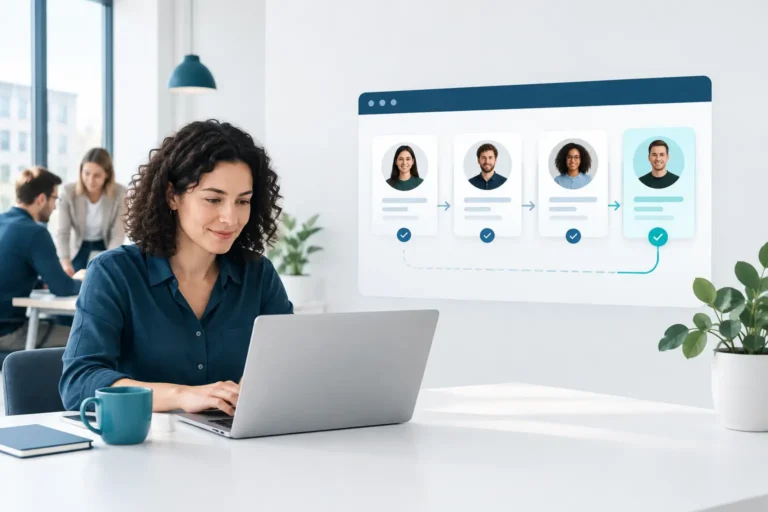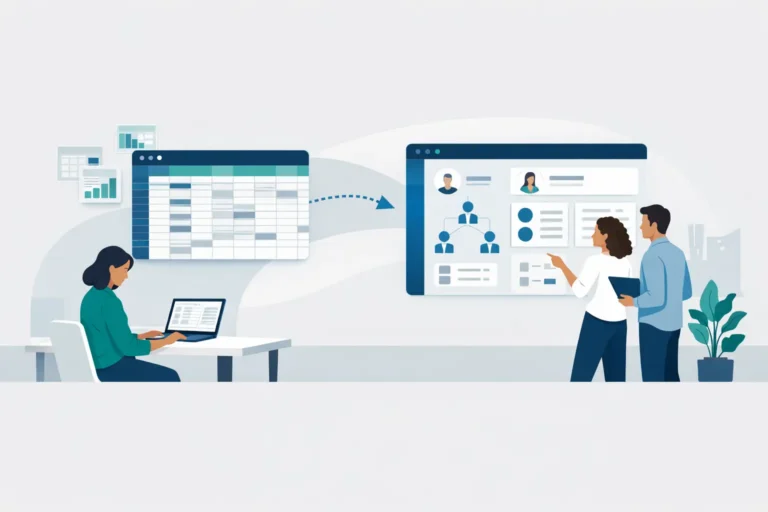
A candidate accepts the offer. Then someone has to rekey their name, salary, manager, start date and contract details into the HR system. IT needs an access request. Payroll needs accurate data. The manager needs an onboarding plan. This handover is where the ATS versus HRIS question stops being a software comparison and becomes an operational decision.
For a growing business, the right answer is rarely about which category has the longest feature list. It is about where your people data begins, who needs it next and how much manual work your HR team can realistically sustain.
What an ATS and an HRIS are designed to do
An applicant tracking system, or ATS, manages the recruitment process. It helps teams publish vacancies, collect applications, screen candidates, schedule interviews, gather feedback and make offers. Its primary record is the candidate and its primary purpose is hiring efficiently.
A human resources information system, or HRIS, manages the employment lifecycle once someone joins. It stores employee records and typically supports onboarding, contracts, leave, time and attendance, expenses, performance reviews, learning and HR reporting. Its primary record is the employee and its purpose is running HR operations consistently.
The distinction sounds neat until you look at daily work. Recruitment data becomes employee data when an offer is accepted. A new starter’s manager, location, job title and working pattern affect payroll, leave entitlement, access requests and reporting. If systems are disconnected, HR has to bridge that gap manually.
| Area | ATS | HRIS | | — | — | — | | Main focus | Attracting and selecting candidates | Managing employees and HR operations | | Core record | Candidate profile | Employee record | | Typical users | Recruiters, hiring managers, interviewers | HR, managers, employees, finance teams | | Key workflows | Vacancies, interviews, offers | Onboarding, leave, time, reviews, compliance | | Success measure | Faster, better-informed hiring | Accurate, efficient people operations |
Neither system is inherently better. A business with high-volume or highly specialised recruitment may need an ATS with deeper sourcing, talent-pipeline or agency-management capability. A business whose greater challenge is administration after hiring may get more value from a broader HRIS first.
ATS versus HRIS: the practical difference after hiring
The most useful way to assess ATS versus HRIS is to follow one hire through their first months.
In an ATS-led process, the candidate applies, interviews and accepts an offer. At that point, the recruitment team has completed its main job. The employee record may be transferred to an HRIS through an integration, spreadsheet upload or manual entry. Each route can work, but each also creates a point where information can be delayed, altered or missed.
In an HRIS with integrated recruiting, the accepted candidate can become an employee record without a separate transfer. The data collected during recruitment can trigger a tailored onboarding checklist, document requests and tasks for the manager. The HR team still checks the information, particularly contractual and payroll fields, but it no longer starts from a blank record.
That matters more as headcount rises. At 15 employees, copying details between two tools may take a few minutes per hire. At 150 employees, across different countries, entities or working arrangements, those small handovers multiply. They also make it harder to answer apparently straightforward questions: Which job title is current? Has the contract been signed? Who is due to start next month? Which data is approved for payroll?
When a standalone ATS makes sense
A dedicated ATS can be the sensible choice when recruitment is complex enough to deserve its own specialist system. This is often true where a company hires at volume, works with several agencies, requires advanced candidate relationship management or has unusually detailed interview workflows.
It can also suit organisations with a mature HRIS already in place, provided the integration is dependable and clearly owned. ‘Integrated’ should not mean that data occasionally moves across. HR should know exactly which system is the source of truth for each field, when records transfer and how errors are handled.
The trade-off is stack complexity. A separate ATS adds another supplier relationship, set of permissions, data-processing review and training requirement. It may be worthwhile, but only where the added recruitment depth solves a real problem. Buying a specialist ATS to manage a modest number of vacancies can leave a small HR team maintaining software that delivers little value after the offer is signed.
When an HRIS with recruiting is the stronger fit
For many SMEs, hiring is one part of a wider people operations workload. The same one to three HR professionals may recruit, prepare contracts, answer leave queries, chase probation reviews, support managers and keep records ready for audits. Their problem is not a lack of tools. It is too many disconnected places to look.
An HRIS with recruiting is often a stronger fit when you want one employee journey from application to exit. Recruitment activity sits alongside onboarding, employee records and ongoing workflows, reducing duplicate administration and giving managers a more complete view of their teams.
This approach is especially useful when your organisation is growing across borders. Employee data needs are rarely identical across European locations, yet teams still need clear records, consistent approval flows and appropriate access controls. Centralising the core process does not remove local complexity, but it makes that complexity easier to manage than a collection of spreadsheets and separate applications.
There is a limit. An integrated recruiting module may not match every advanced feature of a best-of-breed ATS. If talent acquisition is a major strategic function with dedicated recruiters and demanding hiring volumes, assess the depth carefully. The aim is not one platform at any cost. It is the fewest systems needed to run the process well.
The data question is usually the deciding factor
Most ATS versus HRIS decisions eventually come down to data ownership and quality. Recruitment information includes CVs, interview notes and candidate consent. Employment information includes contracts, compensation, leave records, performance data and sometimes sensitive personal data. These records need different retention rules, access permissions and controls.
For European employers, GDPR considerations should be part of selection from the start, not a questionnaire sent after procurement has chosen a preferred supplier. Ask where data is hosted, whether it is isolated from other customers, how access is controlled and how retention can be applied to candidate and employee records. Also establish how you will respond when a candidate asks for their data to be removed or an employee asks to access their records.
A single system does not automatically make an organisation compliant. Poor permissions, unclear processes and incomplete records remain risks. However, a well-configured HRIS reduces the number of copies of personal data circulating in inboxes, shared folders and unofficial trackers. That is a practical improvement for both privacy and day-to-day accuracy.
Questions to ask before choosing
Start with workflows rather than features. Map what happens from a vacancy request through to a new starter’s first working day. Include the tasks that usually sit outside HR software, such as equipment requests, payroll notifications and manager reminders. The gaps will show whether recruitment is the isolated problem or merely the first step in a fragmented process.
Then ask three direct questions. Where is the master employee record? Who re-enters information after an offer is accepted? What work becomes harder if the HR team cannot access a complete, current record? The answers are often more revealing than a vendor demonstration.
It is also worth testing the experience for different users. Hiring managers need a simple way to review candidates and complete actions. Employees need straightforward self-service for requests and documents. HR needs controls, reporting and confidence that changes are recorded correctly. A system that looks impressive to a project team but creates friction for managers will generate workarounds quickly.
Finally, assess the platform’s ability to grow with you. Your needs at 40 employees may centre on hiring and leave. At 200, you may need structured onboarding, multi-level approvals, performance cycles and clearer reporting. Replacing tools every year or two is costly, even when each individual tool appears affordable.
Choosing for the whole employee lifecycle
The best decision is the one that reflects the shape of your organisation, not the loudest software category. If recruitment is highly specialised, a standalone ATS connected to a capable HRIS can be justified. If your priority is removing manual handovers and giving a small HR team one reliable view of people data, an integrated HRIS is usually the more practical starting point.
C2 is built around that latter need: recruiting, onboarding and core HR operations in one platform, with single-tenant PaaS and EU data residency for organisations that need stronger control over their data.
Before selecting any system, run a real vacancy and new-starter scenario through it. The right platform should make the next hire easier to welcome, not simply easier to process.