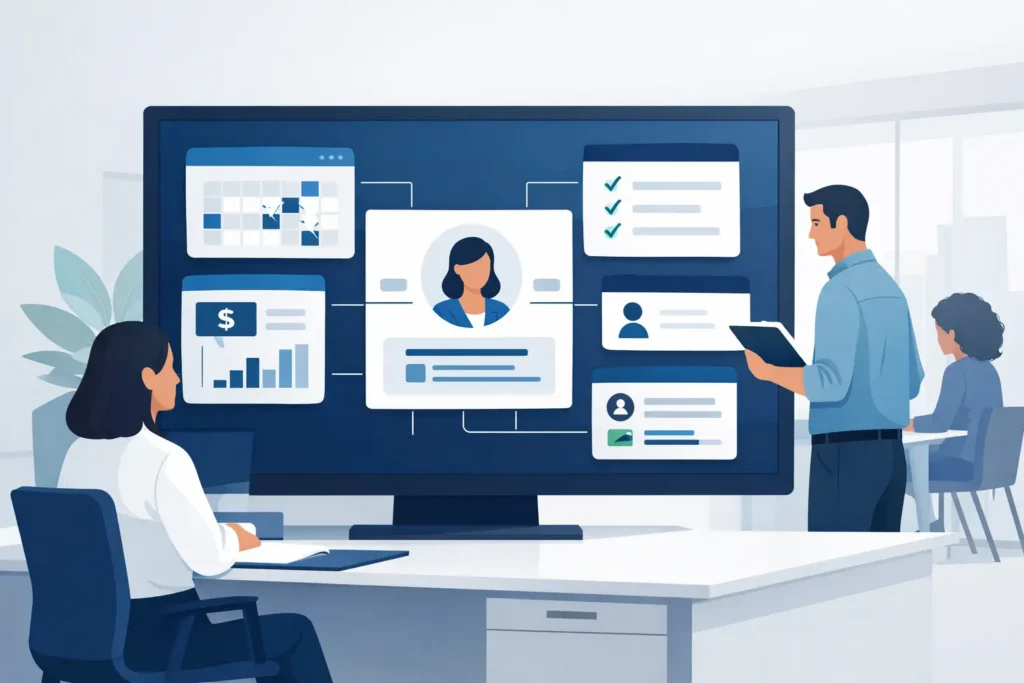
If your HR team still hires in one tool, tracks time in another, approves leave by email, and pulls reports from three spreadsheets, the problem is not effort. It is fragmentation. An all in one HRIS is supposed to remove that drag, but many systems simply move it into a nicer interface.
For small and mid-sized companies, that distinction matters. When you have one to three people handling recruiting, onboarding, payroll inputs, employee questions, policy updates, and compliance tasks, every extra handoff creates risk. Data gets re-entered, deadlines get missed, and managers stop trusting the process because it feels inconsistent.
What an all in one HRIS actually means
The phrase gets used loosely. Some vendors call themselves all in one because they offer a core HR database plus a few add-ons. Others bundle together acquired products that still behave like separate systems behind the scenes. From the buyer side, the better question is simple: does the platform let your team run day-to-day HR work from one place without rebuilding the process outside the system?
A true all in one HRIS should connect the full employee lifecycle. Recruiting should feed onboarding. Onboarding should feed employee records. Time off, attendance, expenses, performance, and learning should all update from the same source of truth. Managers should not need separate logins to complete routine tasks, and HR should not need to reconcile conflicting records every month.
That does not mean every company needs every module on day one. It means the platform should support growth without forcing you back into a patchwork stack six months later.
Why growing teams outgrow disconnected HR tools
In the early stage, separate tools can look reasonable. A startup adds an applicant tracking system because hiring ramps up. Then it adds time tracking for hourly teams, a leave tool for manager approvals, and a performance app because review cycles became painful. Each decision makes sense on its own.
The trouble shows up later. Employee data lives in multiple places, so simple changes like a title update or manager switch have to be repeated manually. Reporting becomes a monthly clean-up exercise. Compliance tasks depend on remembering which system holds the latest version of a policy acknowledgment, contract, or attendance record. Even small changes require coordination across vendors.
This is where an all in one HRIS earns its value. Not because consolidation looks tidy on a slide, but because it reduces operational friction in the work your team does every week.
The problems an all in one HRIS should solve
The first problem is duplicate work. If a new hire is entered during recruiting, then re-entered for onboarding, then updated again for time tracking and expense approvals, your process is already costing more than the subscription line item suggests. Good systems remove that repetition.
The second problem is weak visibility. HR leaders need basic answers quickly: who is still missing onboarding tasks, which teams have high absence rates, where review cycles are slipping, and whether headcount data matches reality. When information is split across tools, reporting becomes slow and questionable.
The third problem is inconsistent manager experience. Managers should not need training on five separate workflows just to approve leave, submit feedback, review team attendance, and sign off on expenses. If the process feels fragmented to them, adoption drops.
The fourth problem is compliance exposure. This is especially relevant for companies operating across European markets, where documentation, data handling, and employee processes need more discipline than many small teams can realistically maintain with manual systems. A platform should make compliant behavior easier, not depend on heroic follow-up from HR.
What to look for in an all in one HRIS
Start with process flow, not feature volume. A long feature list is easy to assemble. What matters is whether the system supports the way work moves across your business.
Recruiting and onboarding should be connected. Once a candidate is hired, the system should carry key information forward automatically, trigger document workflows, assign onboarding tasks, and give managers a clear view of what needs to happen before day one.
Core HR records should sit at the center. That sounds obvious, but many companies end up with a system of record that is technically central and operationally ignored. The best setup is one where employee data updates once and flows everywhere it should.
Time and attendance, leave, and expenses should not be isolated admin functions. They affect planning, approvals, and employee trust. If an employee has to ask HR whether a leave request was approved because status updates are unclear, the software is not doing enough.
Performance and learning should also connect back to employee records and manager workflows. Not every company needs advanced talent features immediately, but most do need a practical way to run reviews, document goals, and support development without launching another standalone product.
Where many all in one HRIS platforms fall short
Some systems are too broad for mid-sized companies. They were built with enterprise complexity in mind, and that complexity shows up in implementation time, admin burden, and cost. A smaller HR team may end up buying capability it will never realistically use.
Others are too shallow. They claim to cover the full HR lifecycle, but once you get beyond basic employee records, the workflows are thin. That often leads buyers back to bolt-on tools, which defeats the point of consolidation.
Then there is the data model problem. If a vendor has stitched together multiple acquired products, the experience may look unified at the surface while the underlying data remains segmented. You feel that when reports do not line up, permissions become awkward, or automation stops at module boundaries.
This is also where infrastructure matters more than many buyers expect. For companies that care about control, privacy, and data residency, especially in Europe, architecture is not a technical footnote. It affects risk, flexibility, and trust over the long term.
AI in an all in one HRIS: useful when it removes work
AI has become a standard part of HR software messaging, but the practical question is narrower: does it save your team time without creating new review overhead?
Useful AI in an all in one HRIS can help draft job descriptions, generate policy content, answer routine HR questions, and automate repeatable workflows. That is valuable because small HR teams lose hours every week to writing, clarifying, and chasing tasks that follow the same pattern.
But AI is not automatically helpful. If outputs are generic, permissions are unclear, or your company has strict requirements around providers and data handling, AI can create hesitation rather than efficiency. Buyers should ask how flexible the setup is, what data is used, and whether the system supports the level of control their organization needs.
How to judge fit for your company
The right platform is not the one with the most modules. It is the one that matches your current complexity while giving you room to grow.
If you have 20 employees and one HR generalist, simplicity matters more than deep customization. If you have 250 employees across several countries, workflow consistency, permissions, and reporting become more important. If your organization is growing through acquisitions or managing multiple legal entities, data structure and compliance controls deserve much more scrutiny.
This is also why buyer conversations should center on operating reality. Ask vendors to show how a hire moves from candidate to active employee. Ask how manager changes affect approvals. Ask how leave, attendance, and expenses interact with reporting. Ask what happens when policy documents need version control and acknowledgment tracking. Those scenarios reveal more than a polished demo ever will.
For European SMEs, this is where platforms like Cognitis.cloud have a clear point of view: one login, one platform, and a dedicated environment that keeps data isolated and under your control. That model will not matter equally to every buyer, but for teams balancing growth with compliance expectations, it is a meaningful difference.
The real business case for an all in one HRIS
The strongest case is rarely just software consolidation. It is cleaner execution.
When HR works from one system, onboarding starts faster, manager approvals happen with less chasing, employee records stay more accurate, and reporting becomes credible enough to support decisions. The savings show up in hours, yes, but also in fewer errors, fewer workarounds, and less dependence on individual memory.
That is why the best buying question is not, “Does this platform do everything?” It is, “Will this make our HR operation easier to run next month and easier to scale next year?”
If the answer is yes, you are not just buying an all in one HRIS. You are buying back focus for a team that probably has very little to spare.
The right system should make HR feel less like constant coordination and more like controlled execution, which is exactly what growing teams need when the business will not slow down for admin.