A growing business rarely sets out to buy five HR tools. It usually happens gradually: one system for recruitment, spreadsheets for leave, another tool for expenses and a shared folder for performance reviews. When that starts creating duplicate work and unreliable data, the question often becomes HRIS versus Workday. But that comparison needs reframing before you can make a useful decision.
Workday is an HR information system, commonly positioned as a broad enterprise HCM platform. An HRIS is the category. The practical choice is not between two identical products. It is between an enterprise-grade platform designed for complex organisations and an HRIS designed around the daily realities of a growing company.
HRIS versus Workday: start with the operating model
The right HR platform should reflect how your organisation actually operates, not simply how many employees you have. A 300-person business operating in one country with a lean HR team has very different needs from a 300-person multinational with several legal entities, detailed financial planning requirements and specialist HR systems teams.
Workday is generally evaluated by organisations that need extensive configuration, sophisticated reporting across large structures and links between people data, finance and planning. Those capabilities can be valuable. They also require decisions about process design, ownership, implementation support and ongoing administration.
For many SMEs, the priority is more immediate: get accurate employee data into one place, give managers useful self-service tools and stop HR from chasing information across disconnected systems. They need a platform that supports recruitment, onboarding, attendance, leave, expenses, reviews, learning and compliance without creating a major technology programme.
That distinction matters because software that is capable of doing more is not automatically a better fit. If everyday changes require specialist help, or a module is too complex for managers to use confidently, the intended efficiency can disappear.
What an enterprise platform is built to handle
There are situations where an enterprise HCM platform is the sensible choice. Workday may warrant serious consideration when an organisation has a large, multi-entity operating model, a dedicated HRIS function and requirements that extend well beyond core people operations.
For example, a business may need highly tailored global processes, advanced workforce planning, complex links to enterprise finance systems or deeply segmented reporting for multiple business units. It may have formal programme governance, implementation resources and internal teams able to maintain the system after launch.
These are not minor requirements. They can justify the investment in a platform with broad enterprise scope. The trade-off is that implementation tends to be a substantial organisational project, rather than a simple software rollout. Processes often need to be standardised before configuration begins, and change management needs as much attention as the technology itself.
If your organisation is heading towards that level of complexity, choosing an enterprise platform early may be a strategic decision. But buying for a future that is still several years away can mean paying for complexity your team does not yet need.
What a growing SME needs from an HRIS
For HR teams of one to three people, capacity is usually the constraint. They are handling new starters, employee questions, manager support, absence records and compliance administration alongside longer-term work such as retention and performance. Their system needs to reduce administrative effort, not shift it into system management.
A well-fitted SME HRIS should establish one reliable employee record and use it across the employee lifecycle. A change made during onboarding should not need to be re-entered for payroll preparation, leave tracking or a performance review. Managers should be able to complete routine tasks without turning HR into a helpdesk.
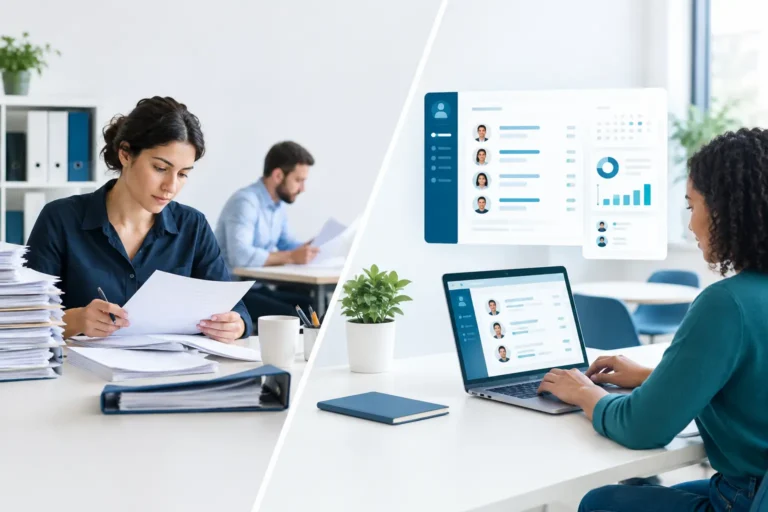
This is also where consolidation produces a measurable operational benefit. When employee data lives in separate tools, HR must continually reconcile records, export reports and investigate which version is correct. A unified platform reduces those handovers. It does not remove the need for sound HR processes, but it gives those processes a dependable home.
The goal is not to replicate every enterprise feature. It is to make the important work easier: recruit well, onboard consistently, track time and leave accurately, manage expenses, support development and maintain the records needed for compliance.
Compare the practical cost, not just the subscription
The headline licence fee is only one part of the decision. A fair HRIS versus Workday comparison should include the total effort needed to implement and run the platform over time.
Consider these five areas:
- Implementation work, including data cleansing, process decisions, configuration and training
- Internal ownership, particularly whether HR can manage everyday changes without specialist support
- Integration needs, such as payroll, identity management or finance systems
- Adoption, including the time managers and employees need to learn new ways of working
- Tool consolidation, meaning which existing subscriptions and manual processes the platform can replace
A lower monthly price is not always lower cost if it leaves you retaining four separate systems. Equally, a platform with a wider feature set may cost more than expected if it demands extensive implementation services and dedicated administrators.
Ask suppliers to describe the work required from your team, not only what their software can do. A clear implementation plan should identify data migration, responsibilities, training and the decisions you must make before go-live. If those answers are vague, the risk has not disappeared. It has simply moved into your project.
Data residency and compliance deserve direct answers
For European businesses, HR software holds some of the most sensitive data in the organisation: contracts, compensation, absence information, performance records and sometimes health-related details. Data protection cannot be treated as a procurement footnote.
Ask where data is hosted, who can access it, how access is controlled and what happens to your data if you change provider. You should also understand whether your environment is shared with other customers or isolated, and whether the supplier can support your internal retention and access policies.
GDPR readiness is not a single feature or badge. It comes from the practical controls around data processing, permissions, auditability, retention and supplier accountability. If you operate across Benelux, DACH or other European markets, local employment practices and documentation requirements can add another layer of detail.
Cognitis.cloud is built for this SME context, with a single-tenant PaaS model and EU data residency. That model will not be the deciding factor for every business, but it can be meaningful for teams that want clear control over sensitive people data without adding a fragmented HR stack.
Choose for your next stage, not an imaginary end state
A useful buying exercise is to map the next 18 to 36 months rather than attempting to predict the next decade. Consider expected headcount, countries of operation, planned acquisitions, payroll arrangements and the HR processes that are currently failing.
If your business expects rapid international expansion, complex entity structures and a larger HR systems team, an enterprise platform may be appropriate. If the more pressing problem is that a small team is switching between spreadsheets and disconnected tools, a focused all-in-one HRIS is often the more proportionate answer.
There is no prize for adopting the largest platform. There is also no benefit in choosing a simple tool that you will outgrow within a year. The strongest choice is the one that your HR team, managers and employees can use well, while giving the business room to grow responsibly.
Before committing, ask to see the workflows your people will use most: adding a new starter, approving leave, submitting an expense, completing a review and producing an HR report. These ordinary moments reveal far more about fit than a feature checklist. The best HR platform is the one that makes work calmer, clearer and easier to trust.