If your HR team is juggling payroll inputs in one tool, leave requests in another, and policy documents in a shared drive, your next HRIS decision will shape more than admin efficiency. The single tenant vs multi tenant HRIS question affects how your data is stored, how changes are made, how easily you can meet compliance requirements, and how much control you really have as your company grows.
For small and mid-sized companies, this choice often gets framed too simply. Multi-tenant is presented as cheaper and easier. Single-tenant is presented as more secure and more expensive. There is some truth in that, but not enough to make a sound buying decision. The better question is this: what operating model will serve your HR team, IT requirements, and risk profile over the next three to five years?
What single tenant vs multi tenant HRIS actually means
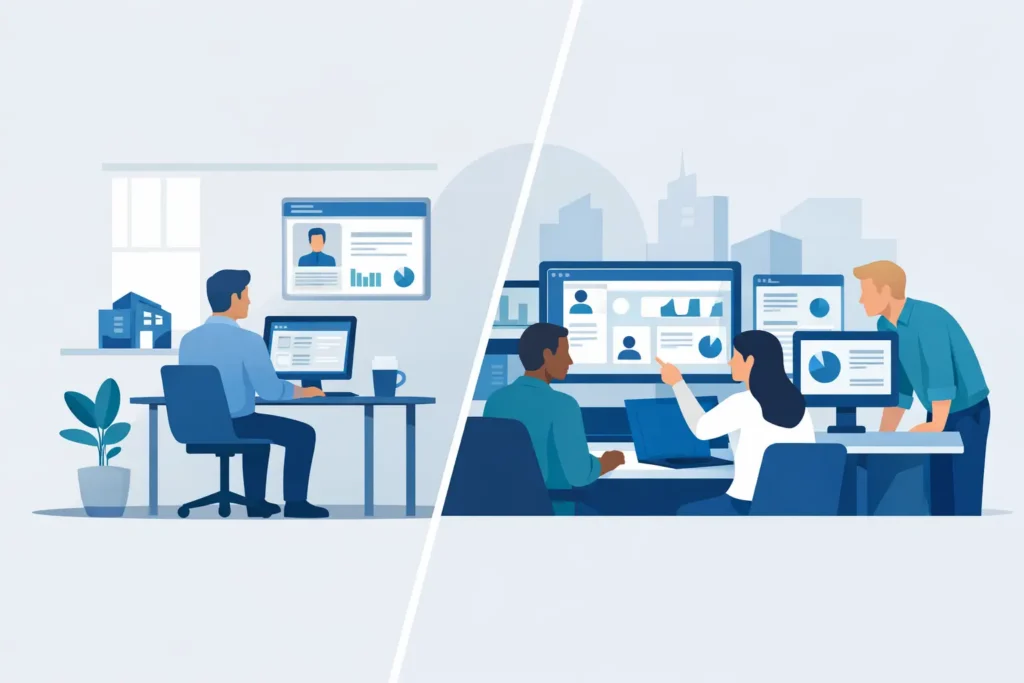
A multi-tenant HRIS is a platform where many customers share the same underlying software environment and infrastructure. Your data is logically separated from other customers’ data, but the application layer is shared. Most mainstream SaaS platforms use this model because it is efficient to maintain and easy to scale across a large customer base.
A single-tenant HRIS gives each customer a dedicated environment. The vendor still manages the platform, but your company operates in its own isolated instance. That means stronger separation at the infrastructure and application level, and usually more flexibility around configuration, data handling, and change control.
Neither model is automatically better. The right answer depends on what your HR operation needs to protect, simplify, and support.
Security and data isolation are not the same thing
When buyers compare single tenant vs multi tenant HRIS, security is usually the first topic. Fair enough. HR systems hold some of the most sensitive data in the business: compensation, performance notes, contracts, leave history, and sometimes health-related records.
Multi-tenant systems can absolutely be secure. Reputable vendors invest heavily in access controls, encryption, monitoring, and testing. Shared architecture does not mean weak architecture.
But security and isolation are not the same thing. In a single-tenant setup, your environment is dedicated to your organization. That can reduce risk exposure, simplify internal reviews, and make conversations with legal, IT, or compliance stakeholders easier. For companies operating across stricter privacy frameworks or handling employee data with elevated sensitivity, that distinction matters.
This is especially relevant if your leadership team asks practical questions like where data is hosted, who can access it, how AI features interact with employee data, or what happens if you need tighter controls than the standard product offers. A dedicated environment often gives clearer answers.
Cost is not just the subscription price
Multi-tenant systems usually win on entry price. Because the vendor spreads infrastructure and maintenance costs across many customers, pricing is often lower and onboarding can be faster. For early-stage companies with simple needs, that can be the right trade-off.
But subscription price is only one part of total cost. HR teams should also consider the hidden cost of workarounds, manual exports, limited configuration, or needing separate tools because the core platform cannot adapt to the business.
A lower-priced multi-tenant platform can become expensive if it forces your team to manage exceptions outside the system. That shows up as extra admin time, higher compliance risk, and frustration for managers and employees.
Single-tenant platforms may cost more upfront, but they can reduce operational friction if your company has specific approval flows, country-level policy differences, or stronger data governance requirements. In practice, the cheapest system to buy is not always the cheapest system to run.
Customisation and control are where the difference gets real
This is where the architecture starts to affect day-to-day HR operations.
Multi-tenant platforms tend to standardize how customers use the product. That is part of the appeal. You get a consistent interface, predictable updates, and guardrails that prevent overcomplication. If your processes are fairly standard, that can be a strength.
The downside is that customisation is often limited to whatever the vendor has chosen to make configurable. Once your HR team needs something outside that boundary, you may hit a wall. That could be a country-specific onboarding step, a nonstandard review cycle, an approval chain for expenses, or a reporting structure that does not fit the product’s assumptions.
Single-tenant environments usually allow more control. That does not mean every company should customise everything. In fact, overcustomisation is a common mistake. But for growing businesses, the ability to align the system with real operating needs can be valuable.
This matters most for SMEs in that awkward middle stage. You are too complex for spreadsheets and point solutions, but you do not want the cost and implementation burden of enterprise software. In that context, flexibility without heavy overhead becomes a meaningful advantage.
Updates, maintenance, and product velocity
One reason multi-tenant vendors like shared architecture is simple: updates are easier to deploy. Everyone gets the same release cycle, often with minimal customer involvement. That creates a consistent product experience and helps vendors move quickly.
For many buyers, that is a benefit. Your team does not need to manage infrastructure, and new features arrive automatically.
The trade-off is control. If a release changes a workflow, reporting logic, or interface behavior, customers usually have limited influence over timing. Most of the time that is manageable. Sometimes it is disruptive, especially for lean HR teams that cannot afford process instability during critical periods like performance cycles, audits, or annual leave planning.
Single-tenant platforms can offer more control over how changes are introduced, tested, or governed. That does not always mean slower progress. It means the vendor can often work with more flexibility around your environment. If your organization values stability and oversight, that can outweigh the convenience of a one-size-fits-all release model.
Compliance questions tend to favor clarity
Compliance is where architecture decisions stop being abstract.
If your company operates in regulated contexts or across multiple jurisdictions, you may need stronger answers around data residency, retention, auditability, and processor relationships. A multi-tenant vendor may still meet those requirements. Many do. But the conversation is often more standardized because the product and infrastructure are standardized.
A single-tenant model can make compliance discussions more concrete. It is easier to explain dedicated environments, isolated data handling, and customer-specific controls to internal stakeholders. That does not remove the need for proper contracts, policies, and technical safeguards, but it can reduce ambiguity.
For European SMEs in particular, this becomes relevant when evaluating where employee data is stored, how AI features are governed, and whether the vendor can support stricter requirements without forcing the company into a much larger enterprise stack. This is one reason platforms like Cognitis.cloud position single-tenant architecture and EU data residency as part of the product value, not just technical detail.
When multi-tenant HRIS is the better fit
Multi-tenant is often the better option if your company wants speed, standardized processes, and a lower initial investment. If you are moving off spreadsheets, have one legal entity, limited complexity, and no unusual compliance demands, a well-designed multi-tenant HRIS can be a smart choice.
It also makes sense when your team prefers product simplicity over configuration freedom. Many HR leaders do not want a highly flexible platform. They want a system that works out of the box and keeps everyone on one clean process.
That is a reasonable priority, especially for smaller teams with limited bandwidth.
When single-tenant HRIS is the better fit
Single-tenant becomes more attractive when control matters as much as convenience. If your organization is growing across countries, handling more sensitive data, or trying to consolidate multiple HR workflows into one platform without losing policy nuance, dedicated architecture starts to pay off.
It is also a strong fit when IT, legal, or leadership care deeply about data ownership, isolation, and hosting choices. The same goes for companies that want AI capabilities but need a clearer say in how models are selected, where data flows, or whether self-hosted options are possible.
In other words, single-tenant is often right for companies that have moved beyond basic HR digitization and now need the system to match how the business actually operates.
The best question to ask vendors
Do not ask only whether a platform is single-tenant or multi-tenant. Ask what that architecture means for your daily work.
How easy is it to adapt workflows? What level of data isolation do you actually get? How are updates handled? Where is data stored? What happens when compliance requirements change? Can the platform support growth without adding more disconnected tools?
Those answers will tell you more than the label alone.
A good HRIS should reduce admin, support better decisions, and give your team confidence that the foundation will hold as the company grows. Architecture is part of that foundation. If you choose with your real operating needs in mind, you will feel the difference long after the procurement process is over.
The smartest HR tech decisions are rarely about buying the most features. They are about choosing the model that lets your team work simply, stay compliant, and keep control where it counts.