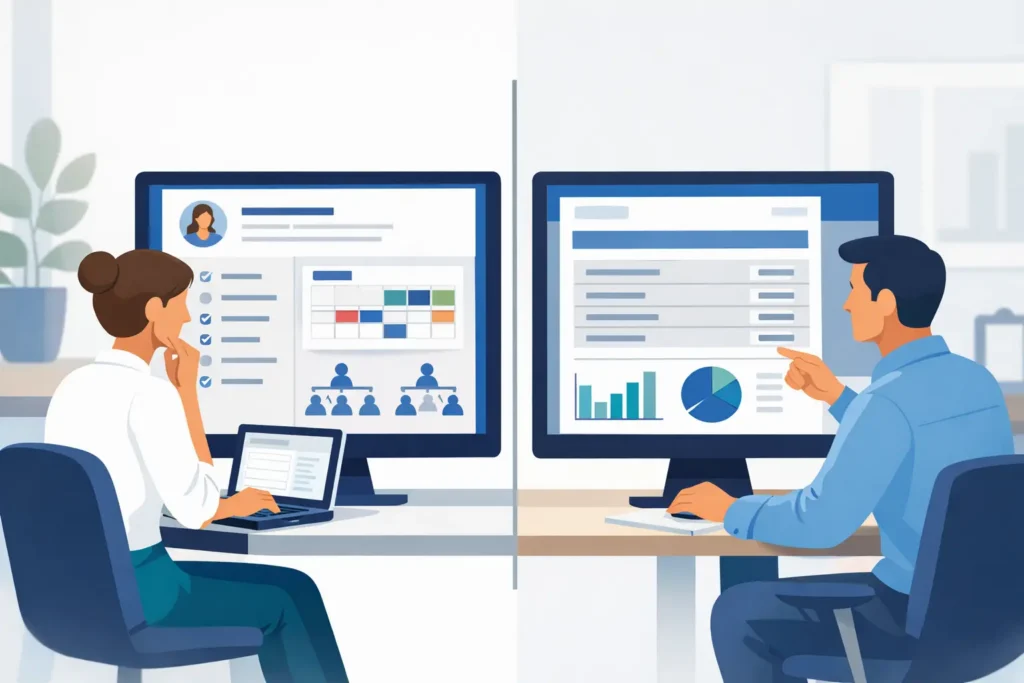
A payroll error is rarely just a payroll problem. It can start with an unrecorded absence, an outdated bank detail, a manager approving overtime too late or a new starter whose contract data lives in an inbox. That is why the question of HRIS vs payroll software matters for growing teams: the two systems solve connected but different problems.
For an SME, the aim is not to buy the most software. It is to establish a dependable flow of people data from recruitment through to pay, without asking a small HR team to re-enter the same information across spreadsheets and portals. The right choice depends on your operating model, the countries you employ in and where your current process breaks down.
HRIS vs payroll software: the core difference
An HRIS, or Human Resources Information System, is the central record of your workforce. It manages the employee lifecycle: personal details, contracts, organisational structure, onboarding, leave, time and attendance, expenses, performance, learning and HR documents. Its primary job is to give HR, managers and employees one reliable place to manage people processes.
Payroll software calculates and processes pay. It applies salary, tax, social security contributions, pension deductions, statutory payments and other payroll rules. Depending on the provider and country, it may also generate payslips, make payment files and support required reporting to authorities.
Put simply, an HRIS answers questions such as: Who is employed? What is their approved leave balance? Has their manager signed off their overtime? Which policy applies to them?
Payroll software answers: What should this person be paid this period, what deductions apply and what needs to be reported or paid?
The boundary is not always neat. Some payroll systems include basic employee records and leave functions. Some HRIS platforms offer payroll capabilities or integrations. But the main design priority usually remains different: payroll software is built around accurate pay runs and statutory calculation, while an HRIS is built around managing people data and HR workflows across the whole employee journey.
Why the distinction becomes urgent as you grow
At ten employees, a shared spreadsheet, an accountant and a monthly check-in may feel sufficient. By 50 or 100 employees, that arrangement often creates friction. Holiday records differ between HR and payroll. Managers submit timesheets late. New-starter data is collected more than once. HR spends the days before payroll chasing changes rather than supporting people and managers.
This is not a sign that the team is disorganised. It is a predictable consequence of growth. The number of data changes rises with every hire, promotion, absence, location change and policy exception. If every change must be copied manually into another system, the risk of delay and error rises too.
For European employers, complexity can increase further when teams work across borders. Payroll rules, reporting requirements and local employment practices vary by country. A platform that works well for core HR data may not calculate payroll in every jurisdiction, while a local payroll provider may have little visibility of performance reviews, training records or recruitment activity.
That is why many growing businesses need both capabilities, rather than treating HRIS and payroll as interchangeable categories.
What each system should own
Clear ownership prevents duplicate records and awkward reconciliation before payday. In most setups, the HRIS should be the source of truth for employee and organisational data. It is where HR maintains contracts, job titles, managers, work locations, leave policies and approved changes.
Payroll should own pay calculation, statutory deductions, payroll reporting and the final pay run. Payroll teams or providers need controls over these activities, particularly where local compliance is involved.
The connection between them should carry the agreed data needed for payroll: new starters, leavers, contractual salary changes, approved leave where it affects pay, variable hours, overtime, bonuses and expense reimbursements. The exact fields will depend on your policies and payroll provider.
This division matters because it gives each team a clear responsibility. HR does not need to become a payroll specialist to maintain accurate employee records. Payroll does not need to hunt through email threads to confirm whether a change was approved.
A practical example: the monthly payroll cut-off
Consider an employee whose manager approves overtime on the final day before payroll cut-off. If attendance is recorded in one system, approval sits in email and payroll works from a separate spreadsheet, the HR team has to assemble the evidence manually. One missed message can affect pay.
With a properly configured HRIS, time is recorded against the relevant employee, routed to the right manager and marked as approved. The approved value can then be supplied to payroll in an agreed format or through an integration. It does not remove the need for payroll checks, but it removes avoidable hand-offs.
When payroll software alone is enough
Payroll-only can be a sensible choice for a small, stable organisation with straightforward needs. This may apply when you have one legal entity, limited variable pay, a low volume of employee changes and an accountant or bureau that handles most administration. In that situation, a capable payroll product with a basic employee self-service portal may be proportionate.
It can also be appropriate where a local payroll bureau is essential because of country-specific rules. The key question is whether the lack of a dedicated HRIS is creating operational cost elsewhere. If HR still manages onboarding, leave, documents, performance and expenses through disconnected tools, payroll-only may be cheaper to buy but more costly to run.
A payroll system is not automatically a poor HR system. It is simply unlikely to be designed for every HR workflow that becomes important as headcount grows.
When an HRIS becomes the stronger priority
An HRIS is usually the better next investment when HR is spending too much time coordinating information rather than acting on it. Common signals include inconsistent employee records, leave balances maintained manually, onboarding tasks slipping through gaps, limited reporting on workforce changes and multiple logins for everyday processes.
It is particularly valuable when managers need to play a more active role. Managers should be able to approve leave, complete onboarding tasks, hold performance conversations and access the information relevant to their teams without asking HR to act as a switchboard.
For a team operating across Benelux, DACH or wider Europe, data governance should form part of this decision. Ask where employee data is hosted, whether access can be controlled by role and whether the provider’s architecture fits your privacy requirements. Convenience should not require you to compromise on control of sensitive workforce data.
C2 is designed around this model for SMEs: a single HRIS environment for core people processes, with EU data residency and the flexibility to connect payroll rather than forcing every organisation into the same payroll arrangement.
Integration is valuable, but it is not the whole answer
“Integrates with payroll” is a useful starting point, not a buying decision. An integration can range from a monthly export file to a two-way, near-real-time connection. Neither is automatically better. A controlled monthly export may suit a business with a stable payroll cycle. More frequent synchronisation may help where changes are common, but it also requires careful rules about which system wins when records differ.
Before committing, test the real process. Can the connection handle starters, leavers, salary changes, recurring allowances, multiple work schedules, unpaid leave and retrospective corrections? Are approvals captured before data is transferred? Who monitors failed transfers? Can payroll see why a value changed?
You should also clarify ownership. If a leave balance is corrected in payroll, does that correction return to the HRIS? If not, your team needs a documented process to prevent records from drifting apart. Good integration reduces administration, but good governance keeps it trustworthy.
A decision framework for growing SMEs
Start with your process rather than a feature checklist. Map one complete pay cycle from a new starter accepting an offer to their first payslip. Include every person who touches the data, every approval and every manual export. The gaps will quickly show whether your immediate issue is payroll calculation, fragmented HR operations or both.
Then assess your complexity honestly. Consider the number of entities and countries, hourly or shift-based work, variable compensation, expense reimbursement, collective agreements, statutory leave requirements and the frequency of employee changes. More complexity does not always mean you need enterprise software. It does mean you need clear system boundaries and reliable data flows.
Finally, judge vendors on operational fit. Ask how easily the platform works for employees and managers, not just HR administrators. Check implementation support, data migration, permission controls, reporting and the quality of the payroll connection in the countries where you actually employ people. A platform that promises every feature but requires constant specialist administration may not suit a one- or two-person HR team.
Choose the system that removes the next bottleneck
The best answer is often not HRIS or payroll software. It is an HRIS that gives your organisation a trusted people-data foundation, paired with payroll software or a payroll partner that handles local calculation and reporting well.
Start where the pressure is most visible. If pay runs are incorrect or late, stabilise payroll first. If payroll is accurate but HR spends hours chasing information across five tools, build the HRIS foundation. The useful outcome is not a larger technology stack. It is a calmer monthly process where employees are paid correctly and your HR team has time to focus on the people work that supports growth.