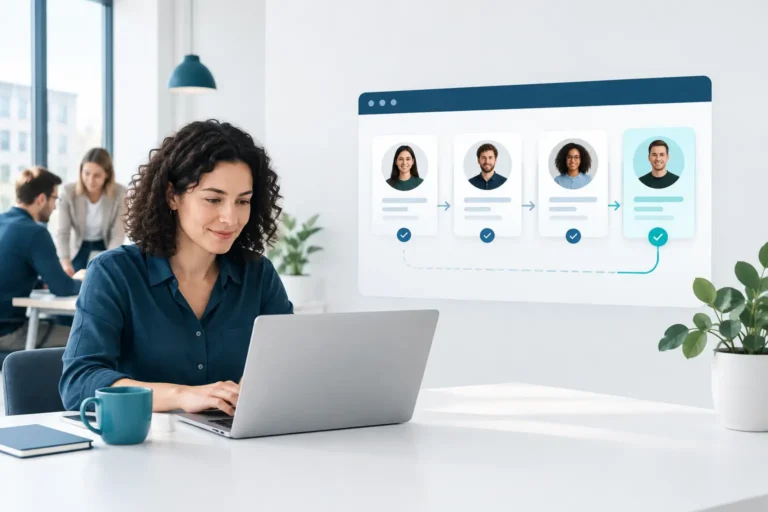
A new hire accepting an offer is the start of a deadline, not the end of a process. Contracts need signing, equipment needs ordering, managers need prompts and payroll, IT and HR need the same joining date. When those tasks sit across email, spreadsheets and separate systems, details are missed precisely when a new colleague is forming their first impression.
The best employee onboarding platforms bring those moving parts into a visible, repeatable process. For a growing European SME, however, the best choice is rarely the platform with the longest feature list. It is the one that gives a small HR team control without creating another system to maintain.
What a good onboarding platform should actually solve
Onboarding software is often assessed through the employee experience: welcome messages, checklists and a tidy portal. Those matter, but the operational test is more demanding. Can HR create a compliant employee record once, trigger the right tasks for each role and location, collect documents securely and hand accurate data to the teams that need it?
A useful platform should cover preboarding as well as day one. That includes sending documents for completion, gathering personal and payroll details, assigning policy acknowledgements and giving managers a clear view of their own actions. After the start date, it should support induction plans, probation check-ins and mandatory learning without HR chasing every task manually.
For companies operating across countries, configuration matters more than attractive templates. A sales hire in Belgium and an engineering hire in Germany may need different contract packs, leave policies, equipment workflows and local compliance steps. The platform should accommodate those differences while preserving a consistent core process.
The final question is where onboarding data goes next. If employee details have to be re-entered into time tracking, performance reviews and learning tools, the process remains fragmented. An HRIS with onboarding built in can remove that duplication, provided its wider modules are a genuine fit rather than features you will never use.
The best employee onboarding platforms to consider
There is no universal ranking because organisations differ in geography, existing systems and HR maturity. These platforms are strong candidates for different reasons.
Cognitis.cloud (C2)
Cognitis.cloud is designed for European organisations with roughly 10 to 500 employees that want onboarding connected to the rest of HR operations. Recruiting, employee records, time and attendance, leave, expenses, performance, compliance and learning sit within one platform, allowing information captured during hiring to support the employee lifecycle rather than remain in a separate onboarding tool.
Its fit is strongest where consolidation and data control are priorities. C2 operates as single-tenant PaaS with EU data residency, meaning each customer has a dedicated, isolated environment. That is a meaningful consideration for HR leaders handling sensitive employee data, especially where a global software provider’s hosting model raises internal questions. Built-in AI can support content creation, HR questions and workflow automation, with OpenAI as the default and other providers or self-hosted models available on request.
The trade-off is straightforward: teams seeking a narrowly focused onboarding product with a large marketplace of specialist add-ons may prefer a more established point solution. C2 is most compelling when replacing disconnected HR tools is part of the brief.
Personio
Personio is a familiar choice for many European SMEs looking for a broad HR platform. Its onboarding capabilities sit alongside core HR, recruiting, absence management and other people processes, helping teams create task lists, collect information and coordinate managers before a start date.
It can suit businesses that want a mature, generalist HRIS and have the capacity to configure processes carefully. Buyers should assess country-specific requirements, implementation support and the modules they genuinely need. A broad suite can be valuable, but it may also introduce cost and administrative overhead if only a portion of it is used.
HiBob
HiBob is often considered by growing, internationally distributed businesses that place significant emphasis on employee experience and people data. Its onboarding workflows, automation and configurable employee profiles can work well for companies with modern HR operations and a need to engage employees across locations.
For a smaller HR team, the key question is whether that flexibility translates into simpler daily administration. Evaluate the effort required to maintain workflows, permissions and integrations over time. It is also worth confirming how the platform supports the specific compliance and data residency expectations of your organisation.
BambooHR
BambooHR is widely known as an accessible HR platform for smaller organisations. It offers onboarding features within a broader core HR product and may be attractive to teams that want a relatively straightforward way to move away from manual files and email-driven checklists.
Its suitability depends on your European operating model. A company with one location and simple requirements may value its usability. A business managing multiple European entities, local policies or more detailed time and attendance needs should examine whether the available configuration and local support are sufficient before committing.
Deel
Deel is particularly relevant when onboarding is closely tied to international hiring, contractors or employer-of-record arrangements. It can help organisations coordinate hiring across borders where employment administration is part of the immediate challenge.
That focus makes it useful for a specific scenario rather than a default HRIS decision. If you primarily employ people through your own European entities and need an integrated home for absence, performance, learning and local HR operations, compare its broader HR functionality with a platform built around that use case.
Workday and SAP SuccessFactors
Large enterprise suites deserve a mention because they set expectations for workflow depth, security and global governance. For complex multinational groups with extensive internal HR operations, they can be appropriate choices.
For a 50-person or 200-person company, they are often more platform than the organisation needs. Implementation, specialist support and configuration can outweigh the benefit of their breadth. Growing SMEs should not mistake enterprise complexity for operational maturity.
How to compare platforms without being distracted by demos
A polished demo tends to show a single new starter following a perfect path. Your evaluation should test the exceptions. Ask each provider to demonstrate a rehire, a late contract change, a manager who misses a task and a new starter in a different country. Those are the moments that expose whether workflows are practical.
Start with the employee record. Find out which information is collected before day one, who can see it and whether it becomes the authoritative record across HR processes. Then test automation: can role, department, location and employment type trigger different tasks, documents and approvals? Can reminders escalate without HR manually checking a spreadsheet?
Next, examine governance. You need role-based permissions, a clear audit trail and a realistic approach to retention and document access. For European SMEs, ask directly where data is hosted, whether the provider offers EU data residency and how its contractual approach supports your GDPR responsibilities. “GDPR compliant” alone is not enough detail for a meaningful assessment.
Finally, look at adoption. Managers will not log into a platform every day merely to complete a checklist. Good systems make responsibilities obvious, keep tasks short and provide reminders at the right time. New starters should know what is expected without receiving a confusing sequence of automated messages.
Build the process before buying the software
Software cannot repair an undefined onboarding process. Before selecting a platform, map the journey from accepted offer to the end of probation. Identify the hand-offs between HR, finance, IT, facilities and the line manager. Decide which tasks are mandatory, which are role-specific and which can wait until the employee has settled in.
Keep the first version disciplined. A new starter does not need every policy, introductory meeting and training course on day one. Prioritise legal documents, access, payroll information, a welcome from the manager and enough context to do useful work. Add development and cultural content across the first weeks.
Measure the process after launch. Useful signals include completion rates before day one, time spent by HR per hire, missing-document incidents, manager task completion and new-starter feedback after 30 days. These measures show whether the platform is reducing administration or simply digitising it.
The right choice should make a new starter feel expected while giving HR confidence that nothing essential has been left to memory. Choose the platform that fits your real processes, your data obligations and the HR stack you want to run two years from now.