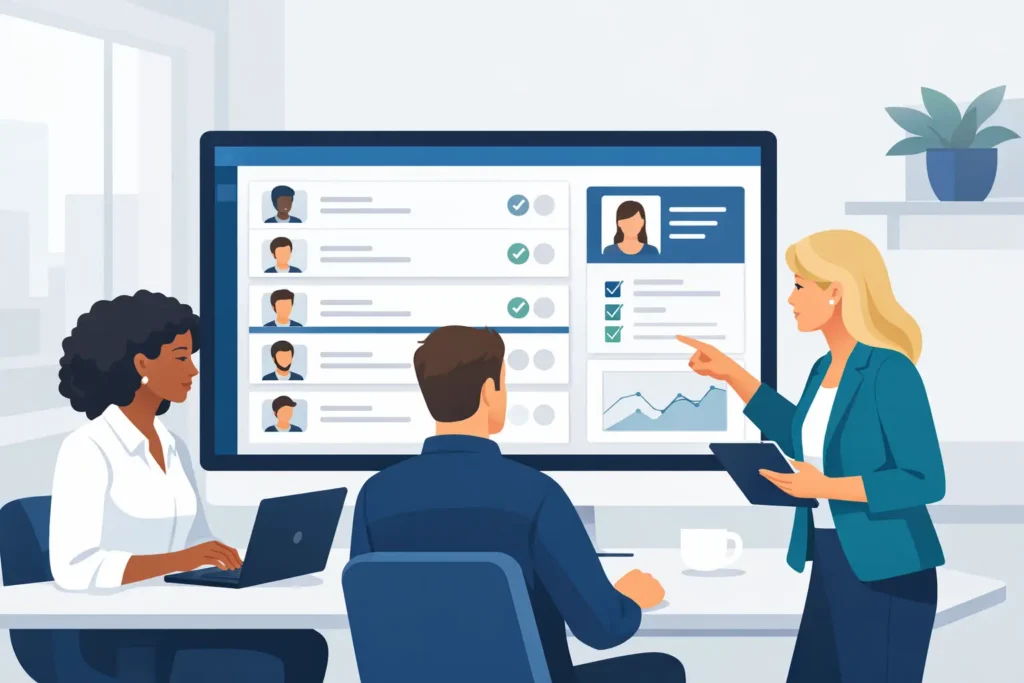
Hiring starts to break down in familiar ways. Resumes sit in inboxes, interview feedback lives in chat threads, and no one is quite sure which candidate got the latest email. That is usually the moment teams start searching for the best applicant tracking software – not because they want more software, but because hiring has become too important to run on guesswork.
For small and midsize companies, choosing an ATS is less about having every recruiting feature on the market and more about getting control. You need a system that makes it easier to move quickly, involve hiring managers, protect candidate data, and hand successful hires into onboarding without creating more admin work for HR.
What the best applicant tracking software actually does
At its core, an applicant tracking system brings structure to recruiting. It centralizes job postings, applications, candidate communication, interview scheduling, evaluation, and reporting. That sounds straightforward, but the difference between a tool that helps and one that frustrates usually comes down to how well it fits your actual hiring process.
The best applicant tracking software gives your team a clear workflow from opening a role to making an offer. Recruiters and HR can see where every candidate stands. Hiring managers can leave feedback in one place. Leadership can get a realistic view of pipeline health instead of chasing updates in meetings.
Just as important, a good ATS reduces avoidable delays. If it takes three clicks to review a resume, seven emails to schedule an interview, and manual copying to move a hire into onboarding, your process will slow down at the exact point where speed matters most. Good software removes friction. It does not just document it.
How to evaluate the best applicant tracking software
Most ATS buying mistakes happen because companies evaluate feature lists instead of day-to-day use. A long checklist can look impressive in a demo, but your HR team has to live in the system every week.
Start with workflow. Can the software match the way your team actually hires? That includes approvals, interview stages, scorecards, offer steps, and communication with candidates. If every small change requires workarounds or support tickets, the tool will become a burden quickly.
Then look at collaboration. Growing companies rarely have full-time recruiting operations. Hiring is shared across HR, line managers, finance, and leadership. The best systems make that coordination easy. Managers should be able to review candidates and submit feedback without training sessions or reminders from HR.
Reporting matters too, but only if it answers real questions. You want to know where candidates drop off, which sources produce good hires, how long roles stay open, and whether your team is keeping up with hiring demand. If reports are hard to build or too shallow to trust, they will not help decision-making.
Finally, pay attention to implementation reality. Some ATS platforms are powerful but built for enterprises with dedicated HRIS teams. That can be a poor fit for an SME with one HR manager doing recruiting, onboarding, and employee administration at the same time. The right system should reduce complexity, not introduce it.
Key features that matter most
Not every company needs advanced recruiting marketing tools or deep agency management. But a few capabilities consistently separate useful ATS platforms from expensive filing cabinets.
Candidate pipeline management is the first. You need a clear view of each role, each applicant, and each stage. That sounds basic, yet many teams still work from fragmented spreadsheets because their software makes pipeline updates harder than they should be.
Automated communication is another priority. Interview confirmations, status updates, rejection emails, and offer steps take time. Automation helps, but it needs guardrails. A system should save time without making candidates feel like they are talking to a machine.
Interview scorecards are often underestimated. Structured feedback improves hiring quality and helps managers compare candidates fairly. It also reduces the common problem where the loudest opinion wins because no one captured evidence during the interview process.
Compliance controls matter more than many SMEs expect. Candidate data is sensitive, retention rules matter, and permission settings should be clear. If your business operates across multiple regions or handles a high volume of applicants, this moves from a nice-to-have to a requirement.
Integration is the other major factor. An ATS should not become another island. If new hires still need to be manually entered into your HR system, payroll records, or onboarding workflows, HR ends up doing the same work twice.
Why integration often matters more than ATS depth
This is the trade-off many buyers miss. A standalone ATS may offer stronger recruiting features on paper, but if hiring data stops there, the downstream work can undo the benefit.
For a growing business, recruitment is only the first step in the employee lifecycle. Once a candidate accepts, you need contracts, document collection, onboarding tasks, system access, policy acknowledgment, and often time-off and payroll setup. If those steps happen in separate tools with no continuity, errors increase and the employee experience suffers before day one.
That is why the best applicant tracking software for many SMEs is not necessarily the tool with the most recruiting bells and whistles. It is often the one that connects hiring to the rest of HR operations. A recruiter might care about pipeline views, but the HR lead also has to think about onboarding, compliance, reporting, and system sprawl.
An all-in-one HR platform with built-in recruiting can be the better choice when your main goal is simplicity and control. That is especially true for small HR teams that cannot afford to manage five disconnected systems. In that context, recruiting efficiency comes from continuity as much as from ATS functionality.
Common mistakes when choosing an ATS
The first mistake is buying for future scale while ignoring current capacity. Yes, your company may double in size. But if the software is too complex for your team today, adoption will suffer and value will be delayed.
The second is overvaluing customization. Flexibility sounds attractive, but too much configuration can turn implementation into a project with no end. Most SMEs benefit more from strong default workflows and a small number of meaningful adjustments.
The third mistake is treating candidate experience and internal efficiency as separate issues. They are linked. Delayed feedback, duplicate outreach, and inconsistent interview stages are usually signs of a broken internal process. Software cannot fix every hiring problem, but it should make good process easier to follow.
Another common issue is ignoring data handling until legal or IT raises a concern late in the buying process. If you store applicant data, use AI-assisted features, or hire across borders, privacy and hosting questions should come early, not after commercial discussions are nearly complete.
A practical shortlist for SMEs
If you are comparing options, narrow your list based on your operating model rather than market popularity. A fast-growing startup with a dedicated talent team may want specialized recruiting depth. A 150-person company with a two-person HR team may be better served by a broader HR platform that includes ATS capabilities.
Look for software that fits three conditions. First, it should be easy for hiring managers to use with minimal hand-holding. Second, it should connect naturally to onboarding and core HR processes. Third, it should meet your data, compliance, and reporting needs without requiring enterprise-level administration.
This is where platforms like Cognitis.cloud can make sense for European SMEs that want recruiting inside a broader HR system, especially when data residency, operational simplicity, and full-process continuity matter as much as sourcing and pipeline management.
How to tell you have found the right fit
The right ATS does not just look polished in a demo. It makes your hiring process easier to run next week. Your HR team should be able to open a role, collect applications, coordinate interviews, and move a candidate to hire without copying data between systems or chasing managers for every action.
It should also support better decisions. When a role is stuck, you should know why. When a source performs well, you should be able to see it. When a candidate asks for an update, your team should have the context instantly.
Most of all, the best applicant tracking software should feel proportionate to your business. Not too light for your process, not too heavy for your team. The goal is not to buy the most software. It is to build a hiring operation that stays organized as your company grows.