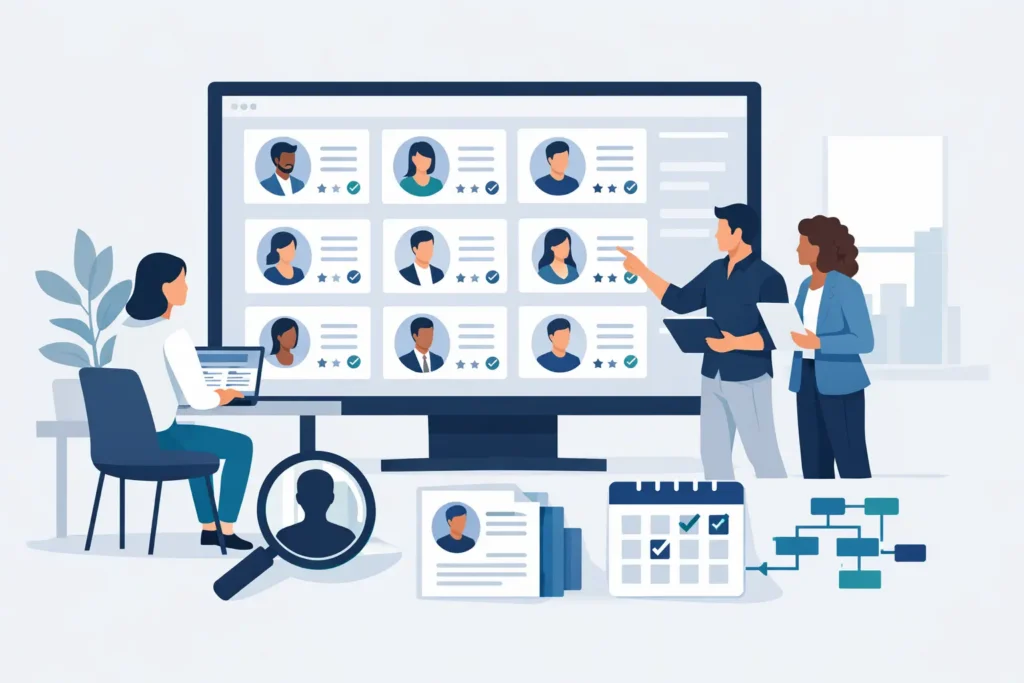
If your hiring process lives across email, spreadsheets, calendar invites, and manager Slack messages, you do not have a recruiting workflow. You have a patchwork. Looking at applicant tracking system examples is often the moment HR teams realize the problem is not just speed. It is visibility, consistency, and control.
For small and mid-sized companies, especially those growing across functions or locations, an ATS is less about adding another HR tool and more about removing recruiting friction. The right system helps you post jobs, track candidates, structure feedback, and move people from applicant to new hire without losing context at every handoff. But not every ATS is built for the same kind of team.
What applicant tracking system examples actually show you
When buyers search for applicant tracking system examples, they are usually trying to answer one of three questions. What does an ATS look like in practice? Which vendors fit our company size? And what trade-offs come with each option?
That is the useful lens here. A list of logos is easy to find. What matters more is understanding the category each system fits into and how that lines up with your hiring model.
Some platforms are recruiting-first and designed for companies with dedicated talent teams. Others are broader HR systems with built-in applicant tracking, which can make more sense for lean HR teams that also manage onboarding, leave, and compliance. There are also enterprise tools that offer deep configuration but ask for more time, budget, and internal support.
9 applicant tracking system examples by use case
1. Greenhouse
Greenhouse is a well-known ATS for structured recruiting. It is often chosen by companies that want strong interview workflows, scorecards, and process consistency across hiring teams.
Its strength is rigor. If your business hires frequently and wants a repeatable process with defined stages and interviewer accountability, Greenhouse can work well. The trade-off is that it can feel heavier for smaller teams that just need to get open roles moving without a lot of system administration.
2. Lever
Lever combines applicant tracking with CRM-style candidate relationship features. That makes it attractive for teams that do a mix of active hiring and pipeline building.
In practice, Lever tends to suit organizations that want recruiting to feel more collaborative and less transactional. If your hiring managers are engaged and your recruiters spend time nurturing candidates, that is useful. If your main need is straightforward requisition management for a small HR team, some of that depth may go underused.
3. Workable
Workable is often considered by SMBs because it is relatively approachable and recruiting-focused. It covers job posting, candidate tracking, interview scheduling, and team collaboration without the complexity of a full enterprise stack.
This is a good example of an ATS that can help a growing company move beyond spreadsheets quickly. The question is what happens after the hire. If onboarding, employee data, and time-off workflows still sit elsewhere, you may solve one problem while keeping the broader HR stack fragmented.
4. Breezy HR
Breezy HR is aimed at smaller teams that want an easy-to-use hiring tool. It is known for visual pipelines and a lower barrier to adoption.
For companies hiring at modest volume, that simplicity is a real advantage. The downside is that lighter systems may start to show limits as reporting, permissions, and cross-functional workflows become more complex. What feels refreshingly simple at 50 employees can feel narrow at 250.
5. Recruitee
Recruitee is built around collaborative hiring and is often popular with fast-growing teams. It gives hiring managers a more active role and supports shared visibility across the process.
That can be a strong fit when recruiting is a team sport. It is less ideal if your process depends on tight central control from HR or if you need applicant tracking to connect closely with broader HR operations after offer acceptance.
6. Ashby
Ashby has gained attention with data-rich recruiting workflows and analytics. Teams that care deeply about funnel conversion, sourcing efficiency, and operational reporting often find it appealing.
This is one of those applicant tracking system examples that shows how far modern ATS tools can go beyond simple applicant storage. At the same time, analytics-heavy platforms tend to deliver the most value when there is enough hiring volume and internal maturity to act on the data.
7. BambooHR
BambooHR is better known as an HR platform than as a pure-play ATS, but that is exactly why it belongs on this list. Many smaller companies do not need a standalone recruiting tool. They need hiring plus a clean handoff into employee records and onboarding.
That broader approach can reduce duplicate data entry and tool sprawl. The trade-off is that recruiting functionality may not be as deep as specialist ATS vendors for companies with high-volume or highly structured hiring.
8. Personio
Personio is often considered by European SMBs that want core HR and recruiting in one platform. Its appeal is operational consolidation rather than best-of-breed recruiting alone.
For lean HR teams, that matters. When one team is responsible for hiring, onboarding, time off, and documentation, disconnected systems create avoidable admin. A broader platform can simplify operations, though companies with unusually complex recruiting needs may still prefer a dedicated ATS.
9. Cognitis.cloud
Cognitis.cloud is an example of a broader HRIS approach that includes recruiting as part of one connected platform. For HR teams that want applicant tracking without adding another isolated system, that model is worth attention.
The practical benefit is not just posting jobs or moving candidates through stages. It is what happens next. Recruiting, onboarding, time and attendance, leave, expenses, performance, compliance, and learning sit in one environment, which reduces handoffs and duplicate work. For growing SMEs, especially those trying to keep their stack simple while maintaining control over data and compliance, that can be a better long-term fit than buying a standalone ATS first and solving integration issues later.
How to compare applicant tracking system examples the right way
The biggest buying mistake is comparing ATS tools as if they all solve the same problem. They do not. A startup hiring 10 people a year, a 200-person company opening roles across three countries, and a mature business with a dedicated talent team need different things.
Start with your workflow, not the feature grid. Who opens jobs? Who reviews applicants? How many interviewers are involved? Where does feedback get lost? What happens after the offer is signed? These questions reveal whether you need a recruiting specialist, an HR suite with built-in ATS, or a platform that supports both hiring and downstream people operations.
It also helps to look beyond recruiter efficiency. Hiring speed matters, but so do compliance, access controls, reporting quality, and candidate experience. If managers cannot use the system easily, they will route around it. If HR has to re-enter data manually after every hire, the time savings disappear.
What matters most for SMEs
For companies with 10 to 500 employees, the right ATS is usually the one your team will actually use consistently. That sounds obvious, but many teams buy for the hiring process they hope to have in two years rather than the one they need to run next month.
Ease of use matters. So does implementation effort. If your HR team is small, every extra admin task has a cost. A highly configurable platform can be valuable, but only if someone has the time to configure and maintain it.
Integration strategy matters too. Some teams are comfortable with a best-of-breed stack. Others are already tired of syncing employee data across recruiting, onboarding, payroll, and time-off systems. There is no universal answer here. It depends on whether your priority is specialist depth or operational simplicity.
For many growing businesses, privacy and data governance are also part of the decision, not an afterthought. That becomes more relevant when candidate data, employee records, and AI-supported workflows all sit inside the same environment. Knowing where data lives, who can access it, and how the system fits your compliance requirements is part of choosing well.
A better question than which ATS is best
The more useful question is this: which system fits the way your HR team actually works?
If recruiting is your main bottleneck and you need advanced pipeline management, a dedicated ATS may be the right move. If recruiting is one piece of a much broader HR workload, an all-in-one system may create more value over time because it reduces fragmentation. And if your hiring process is still informal, the best next step may simply be choosing a tool that gets everyone into one shared workflow.
Good software does not fix a broken hiring process by itself. But it does make a good process easier to run, easier to measure, and much easier to scale. That is where applicant tracking system examples become useful – not as a shortlist to copy, but as a way to see which model matches your business before you add another system to manage.
The right ATS should make hiring feel calmer, not busier.