Personio is the dominant HRIS brand in the DACH market and one of the most recognised HR platforms across Europe. It’s well-funded, well-supported and purpose-built for European employment law. If you’re evaluating HRIS options for a German, Austrian or Swiss team, Personio will almost certainly come up in the first round of research.
That visibility is well-earned in some respects. But a strong brand doesn’t always mean the best fit for your specific situation. Personio’s modular pricing structure, the time it takes to go live and its reliance on third-party integrations for learning and development are areas where the experience for smaller European SMEs can diverge significantly from what the brand promise suggests. This comparison covers the points that matter most for teams with 10 to 500 employees who need a practical, affordable and fast-to-adopt HRIS.
What Personio does well
Personio’s HR administration and document management are thorough. Absence tracking, contract management, digital employee files and approval workflows are all handled in a single system that’s been built specifically around European employment standards. For companies with complex HR admin requirements, particularly in Germany, Austria and Switzerland, that depth is genuine.
Its recruitment module is one of the stronger native ATS options available in the European mid-market. Job posting, applicant tracking and offer management are integrated into the same platform as the rest of HR, which reduces the data transfer friction that comes with using a standalone ATS alongside a separate HRIS.
For companies with 100 or more employees and a budget to match, Personio’s breadth of integrations and its implementation support structure make it a solid, well-documented choice. This comparison is most useful for teams that fall outside that profile: smaller SMEs, those operating across multiple European markets beyond DACH, or those that need faster time-to-value without a complex implementation process.
Where Personio falls short for European SMEs
Modular pricing adds up quickly
Personio’s pricing is structured around modules. The core platform covers HR administration and basic workflows, but recruitment, performance management, learning and development, and other functional areas are available as add-ons that each carry their own cost. The entry price looks accessible, but by the time you’ve assembled the modules that a typical SME HR team actually needs, the total is significantly higher than the headline number.
That structure also makes it harder to plan a budget with confidence. Each new requirement means a conversation about an additional module, a new line item in the contract and a potential delay while procurement and sign-off catch up with the operational need.
C2 is all-in-one from day one. Every plan includes recruitment, onboarding, employee management, time and attendance, leave management, performance management, a built-in LMS, an AI HR assistant and dashboards and reporting. The Start-up plan is €4 per person per month, SME is €7 and Enterprise is €10. There are no modules to assemble and no surprises at the contract stage. You can review the full scope on the pricing page before speaking to anyone.
Pricing is not published
Personio does not publish its pricing. Getting a number requires submitting a request and going through a scoping conversation with a sales team. For an HR manager running a parallel evaluation of three or four platforms on a tight timeline, that asymmetry slows the process. You can model the full cost of one option while another remains a placeholder until the sales cycle catches up.
If you need to build a business case or present a budget estimate to leadership before committing to a demo, C2 lets you do that independently. The pricing is public, the scope is clear and the conversation when you do book a demo can focus entirely on fit rather than cost discovery.
Learning and development requires a separate integration
Personio’s core platform doesn’t include a native LMS. Compliance training, onboarding courses, mandatory certification tracking and development programmes require connecting a third-party learning tool. That’s an additional vendor, an additional integration to maintain, another agreement to negotiate and another data flow to manage under GDPR.
For European SMEs with ongoing GDPR awareness training, role-specific compliance requirements or structured onboarding programmes, managing those outside the HRIS creates manual reconciliation work every time you need a complete view of an employee’s record.
C2’s built-in LMS is included from the Start-up plan. Compliance training, onboarding content and development courses sit inside the same platform as the rest of the HR record. Completion data is attached to each employee profile automatically, so audit trails are complete without any manual export or cross-system reconciliation. HR teams consolidating from multiple disconnected tools onto C2 typically save 20 to 30 hours per week on coordination and process management across systems.
Implementation takes weeks, not days
A typical Personio implementation runs from six to twelve weeks, sometimes longer for companies with more complex configurations or multi-country setups. Personio provides an implementation team to support the process, but for a lean HR function managing live operations at the same time, a three-month go-live window has a real cost in bandwidth and in the period where the old system and the new one need to run in parallel.
C2 is designed to go live in 3 to 15 days for Start-up and SME plan customers. Enterprise rollouts take around three weeks. A faster go-live isn’t a trade-off against capability. It reflects a platform designed so that a small HR team can adopt it without a dedicated implementation resource or a lengthy project timeline running alongside their day-to-day work.
AI assistance is limited compared to what’s standard in C2
Personio has introduced automation features and some AI-assisted functionality, but a dedicated AI HR assistant is not a standard inclusion across its plans. Routine employee queries, HR content drafting and repetitive task handling still land in the HR team’s inbox.
C2 includes an AI HR assistant as standard on every plan. It handles common employee questions directly, supports HR managers with content and communication drafting and reduces the volume of routine queries that consume HR team time. For a one or two-person HR function managing 50 to 150 employees, that capacity matters.
How the two platforms compare
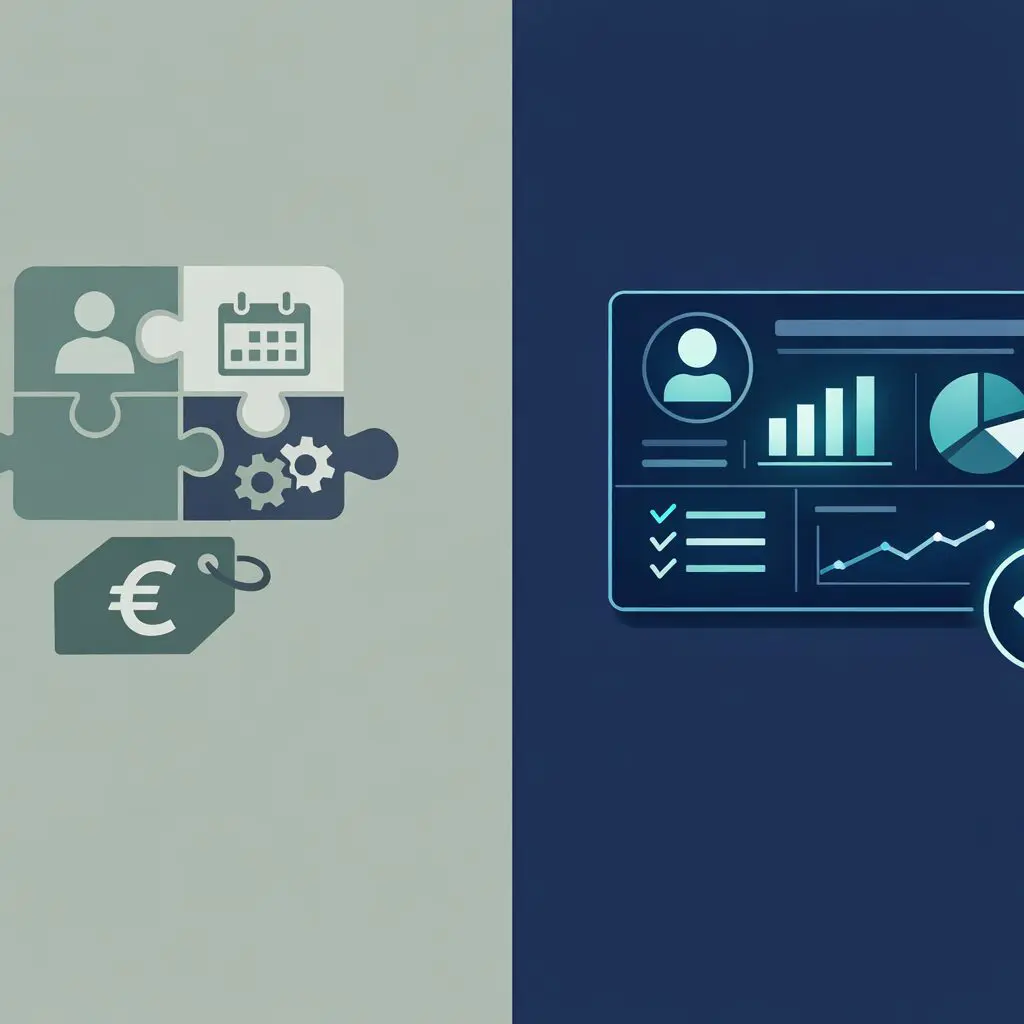
On pricing structure: C2 is all-in-one with a single published per-person price. Personio is modular with quote-based pricing. If you want a clear total cost of ownership before starting a sales process, C2 is the only option that makes that possible from the outset.
On platform scope: both platforms cover core HR administration well. C2 includes a built-in LMS and AI assistant as standard. Personio requires third-party integrations for learning and development, and AI features are not consistently included across plan tiers.
On GDPR and compliance: both Personio and C2 are built within a European regulatory context and offer EU data residency. C2’s Trust Centre is publicly accessible without a login, so compliance documentation is available at any point in your evaluation without a prior sales conversation.
On implementation speed: C2 goes live in days. Personio takes weeks to months. For a small HR team that can’t afford to have two systems running in parallel for an extended period, the difference in go-live time is a practical consideration, not just a convenience.
On market depth: Personio has deeper roots in DACH employment law and a larger integration partner ecosystem in the German market. If your primary need is very deep German-specific HR compliance configuration, that breadth is relevant. C2 covers DACH, Benelux, Nordics, France and UK and Ireland and is designed for multi-country European SMEs rather than single-market depth.
Which platform is right for your team
Personio is a better fit if you’re a larger SME or mid-market company, primarily operating in DACH, with a budget that reflects modular pricing and a timeline that accommodates a thorough implementation process. Its depth in German employment law and its integration ecosystem make it a strong choice for companies where those specific factors are the priority.
C2 is a better fit if you’re a European SME with 10 to 500 employees, need an all-in-one platform at a transparent price that includes recruitment, onboarding, LMS, performance and an AI assistant without assembling modules, and want to go live in days rather than weeks. If your team operates across multiple European countries and you need GDPR documentation available before any sales conversation, C2 is built around that context from the start.
A 30-minute demo covers your specific workflows, your country setup and any questions about compliance or platform scope. Pricing is already public, so the conversation starts from fit. No commitment required.