A colleague needs to know whether they can carry unused holiday into next year. Another cannot find the expense policy. A manager asks how parental leave affects payroll. None of these questions is difficult, but each one pulls a small HR team away from work that needs judgement.
AI employee helpdesk software is designed to handle this pressure. It gives employees a reliable place to ask routine people questions in plain language, while helping HR retain control over the policies, data and escalation routes behind every answer. For growing organisations, the value is not just fewer messages in the shared HR inbox. It is a more consistent employee experience without building a larger support function.
Why the employee helpdesk becomes an HR bottleneck
In a company of 10 people, most questions are answered in a conversation. By 100 people, that approach starts to break down. Policies live across folders, contracts, intranet pages and the memories of experienced colleagues. Employees do not know which document is current, so they ask HR. HR then answers the same question repeatedly, often with slightly different wording depending on who is available.
This is more than an efficiency problem. Inconsistent answers can create confusion around leave, working time, benefits and local employment rules. They also make it harder to identify whether a policy itself is unclear. If twenty people ask the same question about expenses, the answer is not only to respond faster. It may be time to improve the policy or the process.
A conventional ticketing tool can bring order to requests, but it still expects someone to classify, route and answer each one. AI changes the first step. It can interpret an employee’s question, search approved HR knowledge and offer an answer immediately when the issue is suitable for self-service.
What AI employee helpdesk software should do
The useful version of an AI helpdesk is not a chatbot that confidently guesses. It is a controlled employee support layer connected to trusted HR information. Its job is to make the right answer easier to find, not to replace HR judgement.
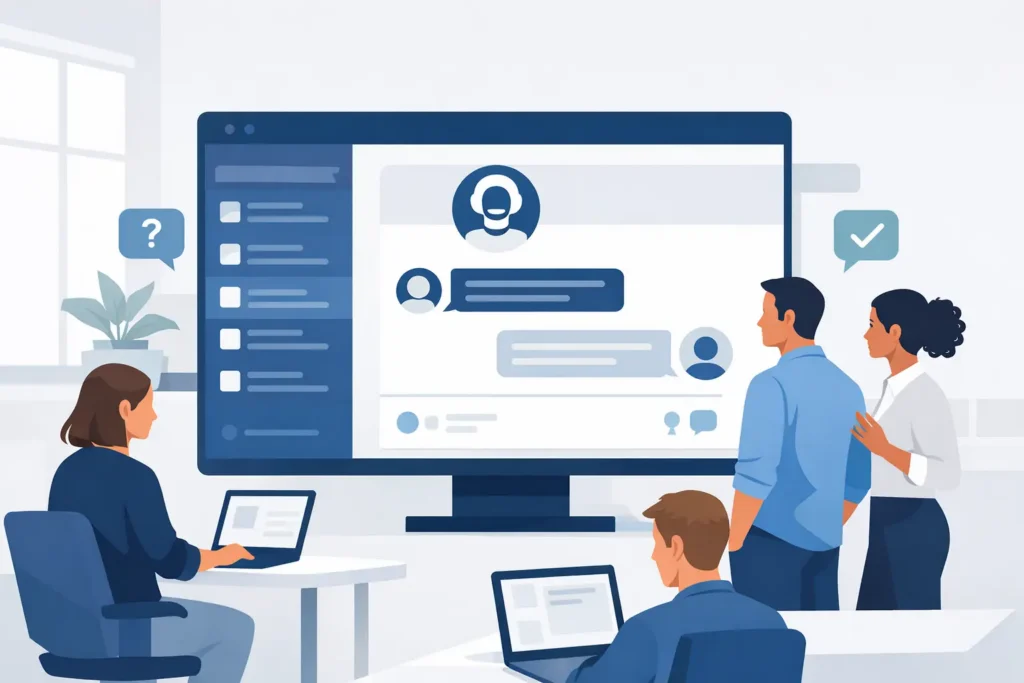
At a minimum, it should understand natural questions rather than force employees through rigid menus. An employee should be able to ask, “How do I request study leave?” and receive a clear answer based on the organisation’s current policy. Where relevant, the system should direct them to the appropriate action, such as submitting a leave request or uploading an expense receipt.
It should also recognise its limits. Questions involving personal circumstances, grievances, disciplinary matters, medical details, contract interpretation or legal uncertainty should be escalated to a named HR contact. A good answer can explain the next step without exposing sensitive information or pretending that a standard rule settles an individual case.
The strongest systems connect helpdesk answers to the wider HR operation. If leave balances, approval workflows, employee records and policy documents sit in separate tools, the AI layer has less context and HR still has to move between systems to resolve exceptions. When the helpdesk is part of the HRIS, the answer, the action and the record can sit in the same environment.
The business case is consistency, not just speed
Time savings are often the first benefit teams notice. If HR no longer answers basic questions about holiday rules, payslips, onboarding steps and expenses several times a week, they can focus on hiring, manager support, workforce planning and employee development.
But speed alone is a weak purchasing case. A fast incorrect answer is worse than a delayed one, particularly where employment rights or pay are involved. The more durable benefit is consistency. Employees receive the same policy-based guidance regardless of whether they ask on a Monday morning or during a busy payroll week.
There is also a management benefit. Well-structured helpdesk data shows what employees struggle to find. Repeated queries may reveal a confusing onboarding process, an unclear absence policy or a manager training gap. That insight is useful because it points HR towards the causes of avoidable work rather than merely processing demand more efficiently.
For multi-country European teams, consistency must not mean one generic answer for everyone. Holiday entitlement, sick pay, working time rules and public holidays can vary by country, contract and collective agreement. The system needs to distinguish between common company guidance and locally applicable rules.
Privacy and control are part of the product
An employee helpdesk will touch personal and sometimes sensitive information. That makes data handling a selection criterion, not an implementation detail. HR leaders should be able to explain where the data is stored, who can access it and which AI provider processes prompts and content.
Voor Europese MKB's, EU-gegevensresidentie and a clear GDPR approach are particularly relevant. A single-tenant environment gives each organisation an isolated instance rather than placing its HR data in a shared application environment. That may not be necessary for every business, but it can provide welcome assurance where employee records, policies and AI features are closely connected.
Provider choice matters too. Some organisations are comfortable using a default large language model. Others have procurement requirements, sector-specific restrictions or a preference for a self-hosted model. The right platform should support an AI approach that fits the organisation’s governance model, rather than making governance adapt to a fixed technical choice.
Before rollout, establish four controls:
- Define which documents and data sources the AI can use, with policy owners responsible for keeping them current.
- Set role-based permissions so employees, managers and HR teams only see information appropriate to them.
- Create escalation rules for sensitive, ambiguous or employee-specific questions.
- Review a sample of questions and answers regularly, especially after a policy or legislative change.
These controls do require effort. However, they are generally far less burdensome than handling every routine query manually, and they make adoption safer.
Where AI should stop and HR should step in
The best employee experience is not one where AI answers everything. It is one where employees quickly get help at the right level. An AI assistant is well suited to stable, documented questions: how to book leave, what receipts are required, where to find a template or what happens during onboarding.
It is less suitable for situations that depend on individual context or carry material risk. Consider an employee asking whether a proposed working arrangement breaches their contract, whether a performance conversation is fair or how a medical condition affects their role. Those questions need a person who can listen, check the facts and apply judgement.
This boundary should be visible to employees. If the helpdesk cannot provide a reliable response, it should say so plainly and make human support easy to reach. Hiding behind an automated answer creates frustration. Clear escalation builds trust.
How to introduce an AI helpdesk without creating another silo
Start with the questions already filling your inbox. Review a few months of HR messages and group them by topic. Most teams find a predictable mix: leave, attendance, expenses, onboarding, benefits, policies and access requests. Begin with high-volume, low-risk questions that have clear documented answers.
Next, tidy the source material. AI cannot compensate for out-of-date policies or contradictory documents. Assign an owner to each policy, remove duplicates and specify which version is authoritative. Plain, well-structured policy writing improves both AI responses and human self-service.
Then make the helpdesk part of everyday workflows. If an employee receives guidance on requesting leave, they should be able to move directly into the leave process. If they ask about an onboarding task, the relevant checklist should be nearby. Separate tools force employees back into searching and HR back into chasing context.
Cognitis.cloud approaches this through one HRIS environment, bringing HR Q&A and workflowautomatisering alongside areas such as leave, time and attendance, expenses, recruiting and compliance. For a growing team, that consolidation matters because it reduces the number of systems HR must maintain and the number of places employees must check.
Finally, measure whether the service is genuinely helping. Track the share of questions resolved without HR intervention, the topics most frequently escalated, employee feedback and changes in repeated queries. Do not treat a high self-service rate as success if employees are receiving unclear answers or giving up. Quality and trust come first.
Choosing the right fit for your organisation
AI helpdesk software is most useful when HR receives a steady flow of repeatable questions and employees need answers outside the moments when the HR team is available. It may be less urgent for a very small organisation with simple policies and close day-to-day contact. Even then, establishing a single source of truth early can prevent future disorder as the business grows.
When evaluating options, look beyond the chat interface. Ask how the system uses your policies, how it handles permissions, whether it can escalate to people, where data resides and whether it connects to the HR processes employees need to complete. A helpful answer is only the beginning. The real test is whether it reduces effort while keeping employees confident that their information and questions are handled responsibly.
Start with the questions your team answers most often. They are usually the clearest map to a calmer, more useful HR service.